Want to spend 3 days in Venice and discover the very best the Most Serene Republic has to offer? Look no further: we have the perfect plan to make the most of your long weekend in Venice.
We spent a weekend in Venice in winter and completely fell under its spell. So now we’re sharing our tips and favorite spots for discovering the city, whether you’re traveling as a couple, with family or with friends!
So what’s the best itinerary for 3 days in Venice? Where should you stay? What should you do, see and visit? How much should you budget for a long weekend? We tell you everything here!
Good to know before your trip to Venice:
🕒 Recommended length: at least 3 days to discover the city and take a day trip to Murano and Burano
🛌 Where to stay: Locanda Ca Le Vele in the Cannaregio district, a charming little baroque-style hotel
🎟️ Book in advance (limited spots): skip-the-line tickets for St. Mark’s Basilica, the Doge’s Palace and the Campanile, and the Vivaldi’s Four Seasons concert
The perfect itinerary for 3 days in Venice
Whether you’re a culture buff or more of a wanderer, Venice has plenty of tricks up its sleeve to win you over. This city with a rich history has a unique atmosphere, thanks to its countless alleys and its hundreds of bridges and canals. While Venice immediately brings to mind a romantic gondola ride, its cultural richness and diversity make it a perfect city for a weekend with family, friends or even solo.
This itinerary combines Venice’s must-sees with quieter, less touristy neighborhoods, so you can discover a more local, authentic side of Venice. The last day is dedicated to the islands of the lagoon.
How to spend 3 days in Venice:
- Day 1: St. Mark’s Square, St. Mark’s Basilica, the Doge’s Palace, the Bridge of Sighs, the Royal Gardens and Dorsoduro
- Day 2: the San Polo, Castello and Cannaregio districts
- Day 3: the islands of Burano, Murano and Torcello
Find the detailed itinerary and our favorite spots on the map below:
Ready to discover the Most Serene Republic? Hop in your finest gondola and let’s go: we walk you through everything below!
Day 1: The San Marco and Dorsoduro districts
1. The San Marco district
San Marco alone is home to most of the places and monuments to see in Venice. Right in the center of the city, it’s the obvious place to start a 3-day weekend in Venice.
St. Mark’s Square
Sometimes flooded with water during acqua alta, sometimes flooded with tourists, St. Mark’s Square is still the most essential spot in Venice. Supposedly called “the drawing room of Europe” by Napoleon Bonaparte, San Marco is one of the most beautiful paved squares in Europe. It’s also the only square in the city to be called a “piazza.”
The square is a must for its architecture and because it’s home to the city’s main landmarks: the Doge’s Palace, the Campanile, the Clock Tower and the Royal Gardens.
It’s surrounded by the “Procuratie,” the former homes of the procurators (officials in charge of running the city of Venice), which now house luxury shops. On sunny days, San Marco fills up with the terraces of famous (and expensive) cafés like Caffè Florian and Caffè Quadri.
We highly recommend heading up to the top of the Campanile, where you can look down on the square and the geometric patterns formed by some of its white paving stones.
St. Mark’s Basilica
St. Mark’s Basilica dates back to the 11th century and was long the center of religious life in Venice. Covered in gold, the monument blends Eastern and Western influences. Before going inside, step back to admire this majestic basilica crowned with 5 domes. Don’t forget to look at the mosaics and sculptures that adorn its facade.
Inside, the floor is covered with decorative mosaics and marble, while the walls and ceilings are covered with golden mosaics. Entry to the basilica is free, so don’t miss it! In peak season, you can opt for a skip-the-line ticket, which also includes an audio guide.


The Doge’s Palace
You can’t miss the Doge’s Palace. Along with the Rialto, it’s one of the symbols of the Most Serene Republic. The building is stunning, with its countless columns and arches. It mixes several architectural styles, but Venetian Gothic dominates. Its facade is well worth admiring from the Piazzetta San Marco.
What is the Doge’s Palace? It was the official residence of the doges, the rulers of Venice. For many centuries, the palace was the seat of the Venetian government, where all power was concentrated.
We chose to visit the Doge’s Palace on a guided tour, opting for an original one: the Secret Itineraries tour. On this tour, we went through the prisons, the secret passages and the torture chamber, retraced Casanova’s escape, and went up into the palace attic where a scene from Inferno, the Da Vinci Code sequel, was filmed… We then continued on our own to see the palace’s more classic rooms: the armory, the Chamber of the Council of Ten, the Golden Staircase… We highly recommend this tour!
Practical information:
💵 Price: about $34 or $45 depending on the tour (2026 prices)
🕘 Hours: daily, 9 a.m. to 6 p.m.
⏳ Time needed: 2 to 3 hours


The Bridge of Sighs
Next to the Doge’s Palace stands the legendary Bridge of Sighs, which owes its name to the prisoners who crossed it on their way from their cells to the interrogation rooms. The crossing gave them one last beautiful view before their sentence or the painful moments that followed.
The fully enclosed bridge prevented prisoners from escaping by jumping into the water. It also has two completely separate corridors, so prisoners couldn’t talk to each other when one was heading to questioning and another was returning to his cell.
The classic view from the waterfront is often blocked by the crowds jostling on the Ponte della Paglia to look at and photograph it. We recommend heading to the Ponte della Canonica, on the other side, to admire it in peace.

The Campanile
The Campanile is without a doubt the best and most beautiful viewpoint in Venice. This 322-foot (98 m) bell tower, which once also served as a lighthouse, towers over St. Mark’s Square.
The panoramic view shows you just how big the city is, with a lovely view of the island of San Giorgio Maggiore and the Basilica of Santa Maria della Salute. We loved it!
Wait times to get to the top can vary a lot. In February there weren’t many people, but in high season the wait can be very long. A standard ticket bought at the counter costs about $17 per person, while a skip-the-line ticket booked in advance costs about $28 per person.
Practical information:
💵 Price: about $17 per person, $28 with skip-the-line (2026 prices)
🕘 Hours: daily, 9:30 a.m. to 8:45 p.m.
⏳ Time needed: 30 minutes to 1 hour


Giardini Reali (the Royal Gardens)
Tucked behind San Marco are the Royal Gardens. Created by Napoleon, then long neglected, the gardens reopened in 2019. We stumbled upon them by chance and fell for this green garden with its pretty glass greenhouse. Its paths are covered with flowering pergolas, making it a perfect spot for a quiet, shady break.

Palazzo Contarini del Bovolo
One of the most famous palazzi in Venice, it’s known for its original tower jutting out from the facade and its spiral staircase, which earned it the nickname “del Bovolo,” meaning “snail” in Venetian.
For an entrance fee of about $10, you can explore the inside of the palace and climb to the top of the tower for a panoramic view.

Teatro La Fenice
Teatro La Fenice is Venice’s opera house, world-famous for premieres of operas by renowned composers including Verdi and Rossini. Named after the phoenix, the theater has indeed been rebuilt several times after fires. Its current look, faithful to its 19th-century design, is a perfect example of Venetian neo-baroque style.
While the ultimate experience is attending a performance, if you’re short on time or budget you can also visit this iconic venue during the day. Book your tickets in advance to avoid long lines!

Take a gondola ride
A must for couples: the gondola ride! You can’t miss the gondoliers, who won’t hesitate to invite you aboard as you walk around the city.
You can choose between a private or shared ride, each lasting about 30 minutes. You can book directly with the gondoliers stationed around Venice, at a standard rate of about $90 for a 30-minute ride, for 1 to 5 people.
For an experience that’s as beautiful as it is cultural, consider a guided gondola tour. These tours take you through the canals of a specific neighborhood while sharing stories about the history of Venice. For example, this guided tour includes a ride along the Grand Canal, where you can admire and learn about the city’s main monuments.


2. The Dorsoduro district
Ponte dell’Accademia
Dorsoduro is the university district, where museums and art galleries mix with plenty of cheap bars and restaurants, and it’s a lovely place to wander! We recommend starting your walk at the Ponte dell’Accademia, a remarkable wooden bridge with a beautiful view, right across from the Gallerie dell’Accademia. This major museum houses an impressive collection of Venetian paintings.
The Zattere
Continue your walk to the Zattere, the waterfront on the south side of the city, pleasant at any time of day. Along the way, treat yourself to a Venetian spritz, some cicchetti or a gelato from Gelateria Nico, one of the best in Venice! This romantic waterfront walk will take you all the way to the monumental baroque church of Santa Maria della Salute.


San Pantalon
Also worth seeing in Dorsoduro: San Pantalon Church. Its interior hides an amazing trompe-l’œil, far from the simplicity of its facade. Look up and you’ll discover a spectacular 17th-century fresco by Gian Antonio Fumiani, who spent nearly 25 years painting the martyrdom of Saint Pantaleon. His work covers the entire ceiling and is remarkable for its incredible illusion of depth.
Playing with perspective, the fresco makes the ceiling look much higher than it really is, filled with countless figures and striking details. One of the most mind-blowing trompe-l’œil effects we’ve ever seen!

Peggy Guggenheim Collection
Also in Dorsoduro is the Peggy Guggenheim Collection. Housed in Palazzo Venier dei Leoni, this museum showcases a wide selection of modern art, with works by artists like Picasso, Pollock and Duchamp. Admission is about $18, and you’ll need about 2 hours for the visit.
Practical information:
💵 Price: about $18
🕘 Hours: daily except Tuesdays, 10 a.m. to 6 p.m.
⏳ Time needed: about 2 hours
3. Spend the evening on a Venice rooftop
Venice deserves to be seen from above, and the Campanile isn’t your only option!
The city has several rooftops where you can admire the Grand Canal and the rooftops of Venice with a Campari or spritz in hand, like Terrazza Danieli, Sagra Rooftop Restaurant or 28.5 Rooftop.

Day 2: The San Polo, Cannaregio and Castello districts
1. The San Polo district
In the center of Venice, San Polo is the smallest district, but there’s no shortage of things to do! Connected to San Marco by the famous Rialto Bridge, San Polo is packed with points of interest, from its many churches to its beautiful palazzi.
The Rialto Bridge
After San Marco, the Rialto Bridge is probably the most famous monument in Venice.
For centuries it was the only bridge across the Grand Canal, letting residents cross from San Polo to San Marco. Lined with two covered rows of souvenir shops, the bridge is truly majestic. But its popularity makes it a bit of a pain to cross, as it gets extremely crowded, especially in high season.
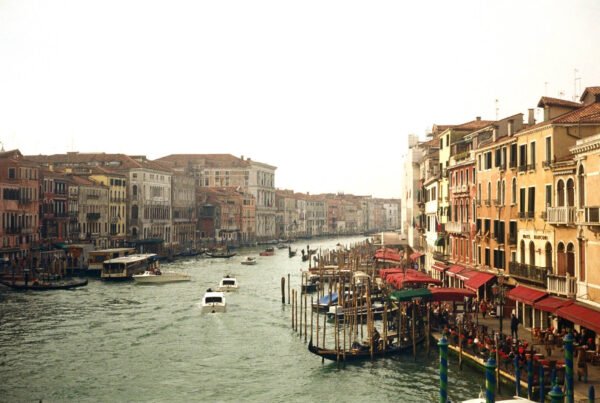
Still, the view from the top is well worth the elbowing it takes to get there. You’ll see an endless dance of boats and gondolas gliding past beautiful Venetian palaces.
If you’re an early riser, you can also wander through the colorful Rialto Market, held in the mornings at Campo della Pescaria.

Basilica of Santa Maria Gloriosa dei Frari
This gigantic brick basilica, built by the Franciscans in the 14th century, is well worth a detour. It holds works by Tintoretto, Donatello and Titian, as well as a remarkable pyramid-shaped funerary monument.
If you like Tintoretto, you can also stop by the Scuola Grande di San Rocco, where you’ll find his Crucifixion.
2. The Castello district
Castello borders San Marco and stretches across the whole eastern end of Venice (known as the “fish tail”). This huge district is home to some of the city’s most beautiful churches, as well as gardens and plenty of restaurants. It’s also where the famous Biennale takes place, hosting many exhibitions.
The Arsenale
The Arsenale is a huge shipyard covering more than 100 acres (40 ha). It’s not open to the public, except when it hosts the Art or Architecture Biennale, but its exterior is remarkable. The pedestrian gate features the winged lion of St. Mark and many other statues, while the water entrance is flanked by two impressive fortified towers.
Near the Arsenale, don’t miss the Church of San Francesco della Vigna, whose two cloisters are well worth a detour.

Campo Santi Giovanni e Paolo
Also called Campo Zanipolo, this square is lined with remarkable buildings. You’ll find the Basilica of Santi Giovanni e Paolo with its Gothic facade, the Scuola Grande di San Marco, one of Venice’s major confraternities, decorated with marble, bas-reliefs and paintings, and the statue of Bartolomeo Colleoni, a Venetian military commander.
The basilica is open to visitors and is home to many sculpted tombs, while the Scuola Grande di San Marco displays works by Tintoretto and other painters.
If you love churches, you can also head south to the Church of San Zaccaria. A mix of Gothic and Renaissance styles, it’s famous for its partly flooded crypt, where eight early doges of Venice are buried. The water creates a unique atmosphere, with the columns reflected on its surface. Entry to the church is free, but the crypt costs about $4.
Libreria Acqua Alta
This bookshop is a well-known Venetian curiosity, where books are piled up in gondolas and bathtubs and cats nap among the old volumes. Walk through the shop and you’ll reach a courtyard where you can climb a small staircase made of books, with a pretty view over a canal.
It’s a charming place, but unfortunately it’s mobbed by tourists, and you’ll be as packed in as the books on the shelves!

3. The Cannaregio district
Cannaregio is the most populated district of Venice, made up of 33 islets. It’s also the most peaceful, far from the tourist crowds (although you may still spot a gondola around a bend in a canal), which is exactly why it’s worth the detour.
Take time to wander and get lost in the alleys, and you might stumble upon Calle Varisco, the narrowest street in Venice at just 21 inches (53 cm) wide, or Ponte Chiodo, one of the last bridges in Venice without railings!


Visit the Ghetto
This is where you’ll find the Ghetto, the only area where the Jewish population was allowed to live from the 16th century on. It really stands out from the rest of Venice, with taller buildings built to cope with population growth and a much more peaceful atmosphere where you can meet locals (which is rare in a museum city like Venice). If you want to escape the crowds, wandering here is the perfect experience.
Don’t miss Campo di Ghetto Nuovo and Campo dei Mori, two squares that perfectly capture the feel of this historic neighborhood. Tintoretto’s house is near Campo dei Mori. If you like the painter, be sure to visit the Church of Madonna dell’Orto, where his works decorate the choir.
Ca’ d’Oro
This is one of the most famous palaces on the Grand Canal. You can’t miss its striking facade rising straight out of the water, which was once covered in gold leaf and lapis lazuli. Inside is Baron Franchetti’s collection, with many works by Tuscan and Flemish painters.
Practical information:
💵 Price: about $9 per person
🕘 Hours: daily except Mondays, 10 a.m. to 6:30 p.m.
⏳ Time needed: about 1 hour
Strada Nova
Strada Nova is one of Venice’s main thoroughfares, part of the route that links the train station to the Rialto and San Marco. Lined with shops, restaurants and cafés, it draws plenty of tourists. As you walk along it, take detours down the side streets to discover more picturesque, quieter alleys.
4. End the day with a Vivaldi concert
What to do in Venice at night? Treat yourself to a concert of Vivaldi’s Four Seasons in the Church of Santa Maria della Pietà.
The church is nicknamed “the Vivaldi church” because the composer worked there in the 18th century. Since 1978, it has hosted concerts honoring Vivaldi and other Venetian composers.
Several evenings a week, the I Virtuosi Italiani ensemble performs one of Vivaldi’s most beautiful works, The Four Seasons. A magical moment in a unique atmosphere that only Venice can offer.
We recommend booking your seats in advance, especially if you’re traveling in high season!
Day 3: The islands of Burano and Murano
For the last day of your trip, we recommend exploring the Venetian lagoon, starting with Burano for the morning and lunch (at Ristorante Pizzeria Principe, which we recommend!). Then make a quick stop on Mazzorbo before hopping back on the vaporetto to Murano for the afternoon, and return to Venice for the evening.
How to get to the islands of Venice
To get to Burano or Murano from Venice, take the line 12 boat, which leaves from Fondamente Nove on the north side of Venice, in Cannaregio. It takes about 10 minutes to reach Murano and 40 minutes to reach Burano.
Single tickets cost about $10.50 (valid for 75 minutes after first use), but if you want to visit both islands on the same day without rushing, we recommend the 24-hour pass for about $28.
Practical information:
⛴️ Transportation: about $10.50 for a single ticket / $28 for a 24-hour pass
⏳ Travel time: 10 minutes to Murano / 40 minutes to Burano


1. Admire Burano’s colorful houses
Burano was originally a small fishing village whose fishermen painted their houses different colors so they could recognize them in the fog. These colorful houses made the island famous and give it all its charm. Since residents must regularly repaint their houses, the colors stay bright, and every alley is a real open-air gallery.
However, the town quickly fills up with tourists, so we recommend getting there early in the morning to enjoy it in peace!
The island is also known for its lace, showcased at the Lace Museum.


2. Stroll through the vineyards of Mazzorbo
Connected to Burano by a bridge, the island of Mazzorbo is much calmer and more rural than its neighbor. Besides a lovely view of the colorful houses and the Venetian lagoon, Mazzorbo is known for the vineyards of the Venissa estate, open to the public in spring. It’s ideal for escaping the crowds in high season.

3. Watch the glassblowers of Murano
Murano is best known for the (very) many glassblowers who work and exhibit there. The island is less charming than Burano and quicker to explore. Don’t miss the lovely Basilica of Santi Maria e Donato. You can also watch glassblowing demonstrations, including at the Scuola del Vetro Abate Zanetti, the school for master glassmakers (unfortunately closed when we visited in February).
Learn more: Murano and Burano: How to visit both islands in one day from Venice

More things to do in Venice
If it’s not your first visit or you’d like to see even more, here are a few other ideas to round out your stay. You’ll find more in our list of 15 must-sees in Venice.
1. Explore Venice’s museums
There are plenty of museums, and they’re a great way to dig deeper (or to stay dry if it rains). Here are a few must-sees:
- Museo Correr: located on St. Mark’s Square, this museum offers a complete dive into the history of Venice, ideal for starting your visit.
- Gallerie dell’Accademia: calling all lovers of Venetian art! This museum’s collections span the 14th to the 18th century, including works by masters such as Bellini, Titian and Tintoretto.
- Ca’ Rezzonico: this 18th-century palace turned museum displays a rich collection of Venetian art from the same period.
- Scuola Grande di San Rocco: decorated by Tintoretto, this confraternity building holds an impressive collection of his 16th-century works.
- Galleria Giorgio Franchetti alla Ca’ d’Oro: housed in the splendid Ca’ d’Oro palace, this gallery displays Giorgio Franchetti’s collection, in a setting once adorned with gold leaf and lapis lazuli.
2. Basilica of Santa Maria Gloriosa dei Frari
This gigantic basilica, a masterpiece of Venetian Gothic architecture, was built by the Franciscans in the 14th century. Made entirely of ochre brick, it holds works by Tintoretto, Donatello and Titian. You’ll also see the Canova Monument, a remarkable pyramid-shaped funerary monument, as well as Titian’s tomb.
3. Basilica of Santa Maria della Salute
Easy to spot, the Basilica of Santa Maria della Salute is one of Venice’s iconic sights. Standing at the entrance to the Grand Canal, it’s famous for its dome, which dominates the lagoon. It was built by the Venetian Senate to mark the end of the 1630 plague epidemic and has inspired countless painters over the centuries.

4. Explore Venice’s secret gardens
Venice isn’t just canals: it also hides beautiful green spaces, with more than 500 gardens to discover! But they’re often hidden behind palace facades. There are the Royal Gardens, of course, which we mentioned earlier, but there are many others in the city where you can find shade, cool air and quiet.
We list the most beautiful secret gardens in this article, but if we had to pick just one, it would be Serra dei Giardini, for its splendid greenhouse in the Castello Gardens.

When to visit Venice
You can visit Venice at any time of year.
Winter, the low season
Our trip together was in February, but we had already visited the city once in the middle of August. We preferred February because there were far (far) fewer people.
We never waited in line, never struggled to find a table in a bar or restaurant, and were lucky enough to get two sunny days out of three. The weather was pretty pleasant and didn’t stop us from enjoying a gelato by the lagoon! We even loved the city’s mysterious atmosphere on overcast days.
Winter is also the season of the Venice Carnival, which usually takes place in February!
Fall, the shoulder season
Fall can also be a good compromise. Temperatures are still pleasant, and there are fewer tourists than in summer.
Spring and summer, the high season
If you’d rather visit in high season, expect higher prices than in winter and some places that are hard to get into without booking ahead. Skip-the-line tickets will be your best friends!
In summer, temperatures can get really high, and even the streets of San Marco can be hard to walk because of the crowds.
How many days do you need in Venice?
We recommend a weekend of 3 full days, since the city is rich and quite spread out. This also gives you a day for the islands of Burano, Murano and maybe Torcello.
If you only have two days, focus on Venice itself. And if you only have one day, stick to the San Marco district, home to the most famous monuments!
Where to eat in Venice
Compared to other Italian cities, Venice isn’t known for its food, and many restaurants could be called tourist traps.
Still, the region has a few specialties you shouldn’t miss: squid ink pasta, cicchetti (small bites eaten like tapas), sarde in saor (Venetian-style sardines) and bigoli in salsa.
Here are our favorite places to eat in Venice:
- Vecia Papussa: to share cicchetti over a Venetian spritz, head to this little spot in Cannaregio where locals come for an aperitivo by the canal at nightfall.
- Trattoria Zaccaria and Trattoria Da Mimmo: for traditional Venetian dishes, head to a trattoria in a less touristy district like Castello. We recommend these two, where we had delicious lunches!
- Farini: for a good, generous and cheap slice of pizza on the go (even if it’s not really the region’s specialty).
- Rosa Salva: for a sweet break, we can’t recommend this pastry shop enough.
- Gelateria Nico: the perfect place for a pistachio gelato by the water, facing the lagoon.



Where to stay in Venice
Each district has its own atmosphere, so it’s important to choose yours carefully.

Staying in San Marco
This district is ideal because it’s very central, but it’s also very touristy, so it’s neither the quietest nor the best for dinner. You’ll still find excellent accommodations there, mostly at the higher end of the price range.
🛌 Find a place to stay in San Marco ➜Staying in Cannaregio
Cannaregio is the nightlife district. Home to the former Jewish Ghetto, it’s now where local students and artists go out at night. It’s a lively neighborhood, packed with great spots for a drink or a bite.
It’s also the one we chose for our 3 days in Venice. We stayed at Locanda Ca Le Vele, a charming little baroque-style hotel that set the mood for our stay. We recommend it: it’s on a quiet street just 8 minutes from the Rialto and 15 minutes from St. Mark’s Square.
🛌 Find a place to stay in Cannaregio ➜Staying in Castello
Castello is one of the largest districts in Venice, where you can get a taste of local life, with its markets and residential streets. It’s also appealing because accommodation prices are lower.
But since it’s a bit out of the way, getting to the main sights from here can take some time.
🛌 Find a place to stay in Castello ➜Staying in Dorsoduro
Known as Venice’s artsy district, Dorsoduro offers a more laid-back, less touristy experience. You’ll find many galleries, museums and Ca’ Foscari University. Hotels are a bit harder to come by, though.
🛌 Find a place to stay in Dorsoduro ➜Staying in Santa Croce
Santa Croce is a quiet residential district with fewer tourists. Close to the Piazzale Roma bus station, it can be convenient for getting around. More modern and with fewer major sights nearby, it has a more local feel.
🛌 Find a hotel in Santa Croce ➜Staying on Giudecca
Giudecca is a quiet island across from Dorsoduro, with a magnificent view of Venice. There are usually fewer tourists, and prices can be more affordable. However, you’ll need to take a vaporetto to reach the heart of Venice, which can take a little time.
🛌 Find a hotel on Giudecca ➜Get an idea of prices in each district with the map below:
How much does a 3-day weekend in Venice cost?
For a 3-day weekend in Venice, our budget came to about $290 per person, not counting flights:
| Expense | Budget per person |
|---|---|
| Restaurants | $118 |
| Hotel | $81 |
| Transportation | $47 |
| Sightseeing | $44 |
| Total | $290 |
Transportation mainly covers the airport transfer to Venice and the vaporetto to the islands of Burano and Murano. To find an affordable flight, we recommend comparing fares on Skyscanner.
That makes Venice a fairly affordable destination! But keep in mind that we traveled in February, in the low season: prices can be higher the rest of the year.
How to get from the airport to Venice
There are several ways to get to Venice from Marco Polo Airport: by water bus or by bus.
We chose the water bus with Alilaguna, because arriving by boat felt more special! To get to Venice (Blue line), boats leave the airport every half hour, and every hour in the other direction.
Expect to pay about $30 per person for a round trip from the airport. Other lines go to Murano, Burano, Torcello… You can also book a shared water taxi transfer!
By bus, it’s cheaper but takes longer, since you first take a bus to the bus station and then a vaporetto (water bus) to the stop closest to your hotel. When you leave the airport, follow the signs for the ACTV bus lines. Take line 5 to Piazzale Roma (Venice’s bus station), then take the vaporetto line that serves your stop. You can book your tickets in advance online.
We don’t recommend regular taxis, since cars aren’t allowed into Venice. The taxi will drop you off at the edge of the city, and from there you’ll have to walk to your hotel or take a vaporetto.
Don’t forget the Venice access fee
Since 2024, the city of Venice has charged an entrance fee to fight mass tourism. On certain peak days between April and July, day-trippers must pay a fee of about $6 per person (more if you book at the last minute; free for children under 14). Overnight guests are exempt but must register. Find all the details on the city’s website.
How to get around Venice
Venice isn’t like other cities: the main way to get around is by boat. Cars are banned from the historic center, so don’t count on getting around by bus or taxi! Here are the two main ways to get around:
- On foot: Venice is fairly small and easy to explore on foot. It’s also the best way to discover the city, wandering from alley to alley and bridge to bridge. That’s what we did during our stay, and we highly recommend it.
- By vaporetto: vaporettos are the public water buses. They’re essential if you plan to visit Burano and Murano, but they can also save you time within Venice itself. A single ticket costs about $10.50 and is valid for 75 minutes. Otherwise, you can get a 24-hour pass for about $28 or a 48-hour pass for about $39. All tickets can be booked in advance on GetYourGuide through Venice’s official tourism office, which can save you long lines in summer.
Is the Venice City Pass worth it?
The Venice City Pass gives you access to many monuments and museums in Venice, makes getting around the city easy and lets you skip some lines. It’s priced per day, with the full version costing about $59 for 24 hours. There are customizable options, depending on whether you want to visit La Fenice or are more interested in museums and churches.
The pass can be worth it if you’re planning lots of cultural visits, but if you only want to see the essentials, it’ll probably be cheaper to skip it.
Interested in the Adriatic region? Check out our Montenegro itinerary, another trip we loved!
Some of the links in this article are affiliate links, which means we earn a small commission if you make a reservation through them. This doesn’t change the price for you, but it helps us continue to create content for our blog, which will always remain free. Thank you for your support 🫶