After spending almost two weeks on a road trip in Montenegro, we can easily say this country completely won us both over! Between hiking in the national parks, swimming in the warm waters of the Bay of Kotor and paddling among the birds on Lake Skadar, Montenegro gave us more than its share of wonders.
So why should you consider visiting Montenegro on your next trip? And what’s the best Montenegro itinerary for your trip? We cover everything in this article!
📍 Our itinerary at a glance:
12 days for about $1,450 per person
6 stops: Biogradska Gora > Durmitor National Park > Kotor > Budva > Ulcinj > Lake Skadar National Park
We drove the whole way in a car rented at Podgorica Airport.
Trip taken in summer 2023, article updated in April 2026 (prices, opening hours, etc.)
Our Montenegro itinerary, stop by stop
Here’s our 2-week Montenegro itinerary. This road trip let us discover most of the country without rushing, and it’s easy to do by car.
- Biogradska Gora (Kolašin): 1 day
- Durmitor (Žabljak): 2 days
- Kotor: 3 days
- Budva: 2 days
- Ulcinj: 1 day
- Lake Skadar (Rijeka Crnojevića): 2 days

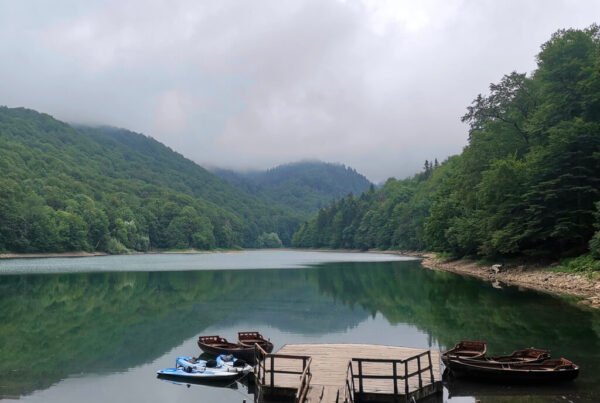
Biogradska Gora National Park (1 day): The stunning Biogradsko Lake
🚌 Getting there: 1 hour 10 minutes by car from Podgorica.
⏰ How long to stay: 1 day is enough to walk around the lake, 2 if you want to do other hikes.
📝 Full guide: Visiting Biogradska Gora: A guide to Montenegro’s primeval forest and glacial lake
Where to stay
We loved staying at Tara Riverside, where we spent a night in a cute little wooden cabin near the park, run by a lovely host.
Our tips for visiting Biogradska Gora
Biogradska Gora is the smallest of Montenegro’s five national parks. It has plenty of hiking trails, but what we really wanted to see was its huge lake, which covers about 57 acres (23 hectares).
We recommend arriving early. We got there around 8 a.m. and had the lake all to ourselves! The mist hadn’t yet lifted from the water, and that view, combined with the stillness, gave the place a wonderfully mysterious atmosphere.


Durmitor National Park (2 days): Montenegro’s most beautiful park
🚌 Getting there: 2 hours by car from Biogradska Gora.
⏰ How long to stay: At least 2 days to enjoy the park’s many activities.
📝 Full guide: Visiting Durmitor National Park: Black Lake, Tara Canyon and the Durmitor Ring
Where to stay in Durmitor National Park
Most visitors stay in the town of Žabljak, but we chose to get away from it all, deep in the mountains, to really immerse ourselves. And we loved it! We stayed at Etno Village Vojnik, in a little cabin tucked away in the mountains among the animals, with a delicious local restaurant and one of the most beautiful starry skies we’ve ever seen.
Our tips for visiting Durmitor
Durmitor National Park is Montenegro’s best-known and most impressive national park. With 48 peaks over 6,560 feet (2,000 m), 13 glacial cirques, 18 mountain lakes, the Tara River Canyon (the deepest canyon in Europe) and some of Europe’s last old-growth black pine forests, it’s a UNESCO World Heritage Site.
We loved exploring its glacial lakes, including the huge Crno Jezero (Black Lake) and Zminje Jezero, the Snake Lake. The Tara River Canyon is really impressive, whether you see it from the Đurđevića Tara Bridge or from the ziplines that cross the gorge.
But our favorite activity was climbing Mount Prutaš, one of Durmitor’s highest peaks at 7,851 feet (2,393 m). Allow about 2 hours to reach the top, where you’ll get a panoramic view of the mountains along the Durmitor Ring and Škrčko Lake.
We recommend at least one day to explore the different lakes, a second one for hiking and, if you can, a third for the park’s adrenaline activities (canyoning or ziplining). You’ll find our full program and all our tips in our dedicated article.
👉 Our complete guide to Durmitor National Park


Kotor (3 days): The Bay of Kotor and around
🚌 Getting there: 2 hours 30 minutes by car from Durmitor National Park.
⏰ How long to stay: At least 3 days for the Old Town, the bay and the surrounding area.
📝 Full guide: Visiting Kotor, Montenegro: What to see, where to swim and where to stay
Where to stay in Kotor
Ideally, find a place close to the Old Town and the waterfront, like the one we stayed in: Apartments Feniks, which we highly recommend (it has a parking space, which is very handy in Kotor).
Our tips for exploring the Bay of Kotor
The Bay of Kotor is one of Montenegro’s must-sees, and cruise lines know it well: big cruise ships are a common sight here. The sea cuts deep into the land, so you swim surrounded by mountains.
We loved exploring Kotor’s Old Town, with its narrow lanes, its Venetian feel and its many stray cats. You can also swim right next to it at Kotor Beach for a dip with a view. For a view from above, head up to Kotor Fortress, which towers over the town at the top of about 1,350 steps.
But the main activity is a boat trip on the Bay of Kotor. We tried the 3-hour cruise with Seamount Kotor. The boat takes you to Our Lady of the Rocks, a church sitting on its own islet, into an old submarine base, past Mamula Fort and into the Blue Cave, passing other towns around the bay such as Herceg Novi.
The area around Kotor is well worth exploring too: Perast, an authentic waterfront village still spared from mass tourism, Mount Lovćen and its panoramic view, the Kotor Serpentine with its 25 hairpin bends, and Cetinje, the country’s historic former capital.
It was one of our favorite stops in Montenegro, and we go into detail in our dedicated article.
👉 Our guide to Kotor and the surrounding area


Budva (2 days): Old town, beaches and fishing villages
🚌 Getting there: 40 minutes by car from Kotor.
⏰ How long to stay: At least 2 days.
📝 Full guide: Visiting Budva, Montenegro: What to see, where to swim and where to eat
Where to stay in Budva
If you have a car, the easiest option is to stay in the new town, as we did at El Mar Apartments.
What to do in and around Budva
Budva is a seaside resort popular with travelers from all over the world, known for its beaches, its nightlife and its old town.
Stari Grad, the Old Town, is well worth a half-day visit for its churches and old stone buildings, even if restaurants and souvenir shops have replaced the homes. For beaches, you can choose between Ričardova Glava, a small beach right next to the Old Town with a superb view, or Mogren and Mogren 2, which are bigger and less crowded.
The Budva Riviera, the coastline around Budva, is full of charm too. There’s of course Sveti Stefan, the former fishing village on its islet that has become the country’s postcard image. But there’s also Pržno, an adorable fishing village that still feels authentic, Petrovac and its old Venetian fortress, and Stari Bar, an old town whose ruins you can visit. For beaches, we loved the long sandy stretch of Jaz Beach.


Ulcinj (1 day): A popular coastal town
🚌 Getting there: 1 hour by car from Budva.
⏰ How long to stay: 1 day is enough.
📝 Full guide: Visiting Ulcinj, Montenegro: Old Town, beaches and where to stay
Where to stay in Ulcinj
To really soak up the atmosphere, we found a charming little hotel in the Old Town that we recommend!
What we thought of Ulcinj
Ulcinj is a seaside resort similar to Budva, mixing beaches, nightlife and an old town.
The Old Town is worth the detour: perched above the beach, it offers a lovely view over the whole town and the sea. It’s also an ideal spot for watching the sunset. The streets are steep and very narrow, so it’s easy to get lost!
Many restaurants there serve good fish dishes with a lovely sea view.
But to be honest, Ulcinj was the stop we liked least in Montenegro. The coast is mostly taken over by party bars, it’s very crowded and there isn’t much to do. For us, it’s not an essential stop, although the drive between Kotor and Ulcinj is worth it, with Sveti Stefan, Petrovac and Stari Bar along the way.


Lake Skadar (2 days): Kayaking, boat trips and swimming
🚌 Getting there: 1 hour 30 minutes by car from Ulcinj.
⏰ How long to stay: At least 2 days.
📝 Full guide: Lake Skadar National Park: Things to do, where to swim and where to stay
Where to stay at Lake Skadar
We stayed in Rijeka Crnojevića, a peaceful little village on the water, in this very comfortable, spacious apartment, where we could rent our kayaks directly!
What to do in Lake Skadar National Park
The main attraction of Lake Skadar National Park, Lake Skadar is the largest lake in the Balkans and straddles the border between Montenegro and Albania. It was also one of the highlights of our trip to Montenegro!
Start with Pavlova Strana, the lake’s iconic viewpoint, which is magnificent at sunset. To explore the lake, we tried two options:
- Kayaking from the adorable village of Rijeka Crnojevića, perfect for having the water and the birds all to yourself.
- This boat tour from Virpazar, with a visit to Kom Monastery, a swim and a cruise on the lake.
We also tried two beaches:
- Pješačac, a 15-minute drive from Virpazar: a very pleasant, quiet beach with a few small piers to dive from.
- Murići, a 2-hour drive from Rijeka Crnojevića: this beach is without a doubt the best place to swim on the lake. A big beach, few people, lots of shade and no algae or pebbles in the water. A real gem.
👉 Our complete guide to Lake Skadar


More places to add to your Montenegro itinerary
Unfortunately, two weeks wasn’t enough to see everything Montenegro has to offer. If you have more time, here are a few more places worth adding to your Montenegro itinerary:
- Ostrog Monastery: Montenegro’s iconic Orthodox monastery is built into a cliff of Mount Ostrog, which makes it truly one of a kind. It’s an easy stop on the way from Durmitor to Kotor.
- Piva Canyon: in the far north, near Durmitor, Piva Nature Park is known for its turquoise reservoir lake and the canyons leading to it.
- Mrtvica Canyon: between Podgorica and Biogradska Gora National Park, this canyon stretches for about 9 miles (15 km) and has lovely riverside hiking trails.
- Herceg Novi: another major town on the Bay of Kotor, Herceg Novi also has an old town, a monastery and a fortress, plus direct access to the Adriatic at Igalo beach.
- Luštica Peninsula: this peninsula sits at the entrance to the Bay of Kotor, and it’s where you’ll find some of Montenegro’s most idyllic beaches.
Budget for a 2-week Montenegro itinerary
In total, we spent about $1,450 per person for 12 days in Montenegro.
Here’s how our budget breaks down:
- Car rental: about $360
- Flights (from Paris): about $320
- Accommodation: about $290
- Restaurants: about $255
- Activities: about $105
- Gas and tolls: about $75
- Groceries: about $35
- SIM card: about $11
- Total: about $1,450
Day-to-day costs are fairly low compared to other European countries. That said, there’s a big difference in prices between the north and the south, especially on the coast between Budva and Ulcinj, where prices can be three times higher than elsewhere.
Our biggest expenses were the flights (booked 5 months ahead on Skyscanner) and the car rental (about $720 in total, also booked 5 months ahead through the DiscoverCars comparison site), which we consider essential.
For lodging, we mostly booked private apartments on Booking.com, with an average budget of about $31 per person per night. For food, we alternated between restaurants and picnics made from whatever we found in supermarkets. The only expense where we set no limit at all: ice cream!
What to know before your trip to Montenegro
Do you need a passport or a visa for Montenegro?
Montenegro isn’t part of the European Union. US, Canadian, UK and EU citizens don’t need a visa for tourist stays of up to 90 days, but you’ll need a valid passport (EU citizens can also enter with their national ID card for short stays). Check the latest entry requirements before you go.
How to get internet in Montenegro
The easiest option is to buy a local SIM card so you can use the internet on your phone (and GPS!). SIM cards are sold at the newsstands in the airport for about $11 for 10 GB, which is more than enough for two weeks.
If you’d rather sort it out in advance, you can pre-order an eSIM from Saily directly on their website and get 15% off your order with the code PROCHAINARRET15.
What currency is used in Montenegro?
Even though Montenegro isn’t in the EU or the eurozone, the local currency is the euro. Credit cards are accepted in most tourist places, but it’s a good idea to carry some cash for small restaurants and markets.
To limit fees on payments and withdrawals abroad, we recommend using a card with no foreign transaction fees.
When is the best time to visit Montenegro?
The best months to visit Montenegro are June and September, both for enjoying the beaches and for easy access to the hiking trails in the north without snow getting in the way.
Keep in mind that July and August are peak season, and you’ll feel it, especially between Budva and Ulcinj, where the crowds are big.
Do you need travel insurance?
Your regular health insurance may not cover you in Montenegro, so we recommend taking out travel insurance before you leave, ideally one that includes medical assistance abroad. Depending on the plan, you can also be covered for your luggage, your bookings or cancellations.
How to get to Montenegro
Flying is the fastest way to get to Montenegro. The country has two airports, in Tivat and Podgorica, both well connected to major European cities. There are no direct flights from the US, so you’ll need to connect somewhere in Europe. We flew into Podgorica with Air Montenegro. Note that Podgorica Airport is very small, so delays are common.
We found our tickets on Skyscanner, where we got the best prices.
Another option is to fly into Dubrovnik and drive to Montenegro from there. It’s a great chance to spend a few days in Croatia before exploring Montenegro.
You can also travel to Montenegro by train if you’re already in Europe: from Paris, for example, go via Munich, Budapest and Belgrade, then on to Podgorica. It’s a much longer trip, but a greener one.
Finally, you can drive there from Western Europe through Germany, Austria, Slovenia, Croatia and Bosnia and Herzegovina. A great way to see the region!
How to get around Montenegro
Rent a car: it’s the easiest way to make the most of the country. Several rental companies have desks at the airport. We used the DiscoverCars comparison site, which got us a car from Sixt at a reasonable price (booking five months ahead).
Take the bus: every town has its own bus station, and plenty of shuttles can take you to more remote sights like Mount Lovćen. Bus stations are the best places to get information about routes and schedules.
Is it easy to drive in Montenegro?
Yes! You’ll mostly drive on main roads limited to 50 mph (80 km/h). Roads are generally in good condition, except in Lake Skadar National Park, and driving is fairly easy. But the country is very hilly and mountainous, so some drives take longer than you’d expect.
🚗 Find all our tips for renting a car and driving in Montenegro in this article.
Looking back on our trip
With nearly 500 miles (800 km) driven across Montenegro, we came home with lots of highlights and, unfortunately, a few disappointments.
We loved this country, especially for its rich nature: the landscapes, the hikes, the lakes, the birds… We enjoyed the Durmitor region so much that we wish we’d stayed a day or two longer. Kayaking on Lake Skadar was another big highlight of our road trip.
We also loved wandering through the old towns along the coast, especially Kotor. The Bay of Kotor is undeniably a must-see, with scenery unlike anywhere else in Europe.
We were less taken with the coast around Ulcinj. In the middle of summer, there were lots of tourists and the traffic was heavy.
In short, we fell in love with Montenegro and have been recommending it to everyone we know since we got back. We hope this article and our experience there have made you want to spend your next vacation there!
Some of the links in this article are affiliate links, which means we earn a small commission if you make a reservation through them. This doesn’t change the price for you, but it helps us continue to create content for our blog, which will always remain free. Thank you for your support 🫶