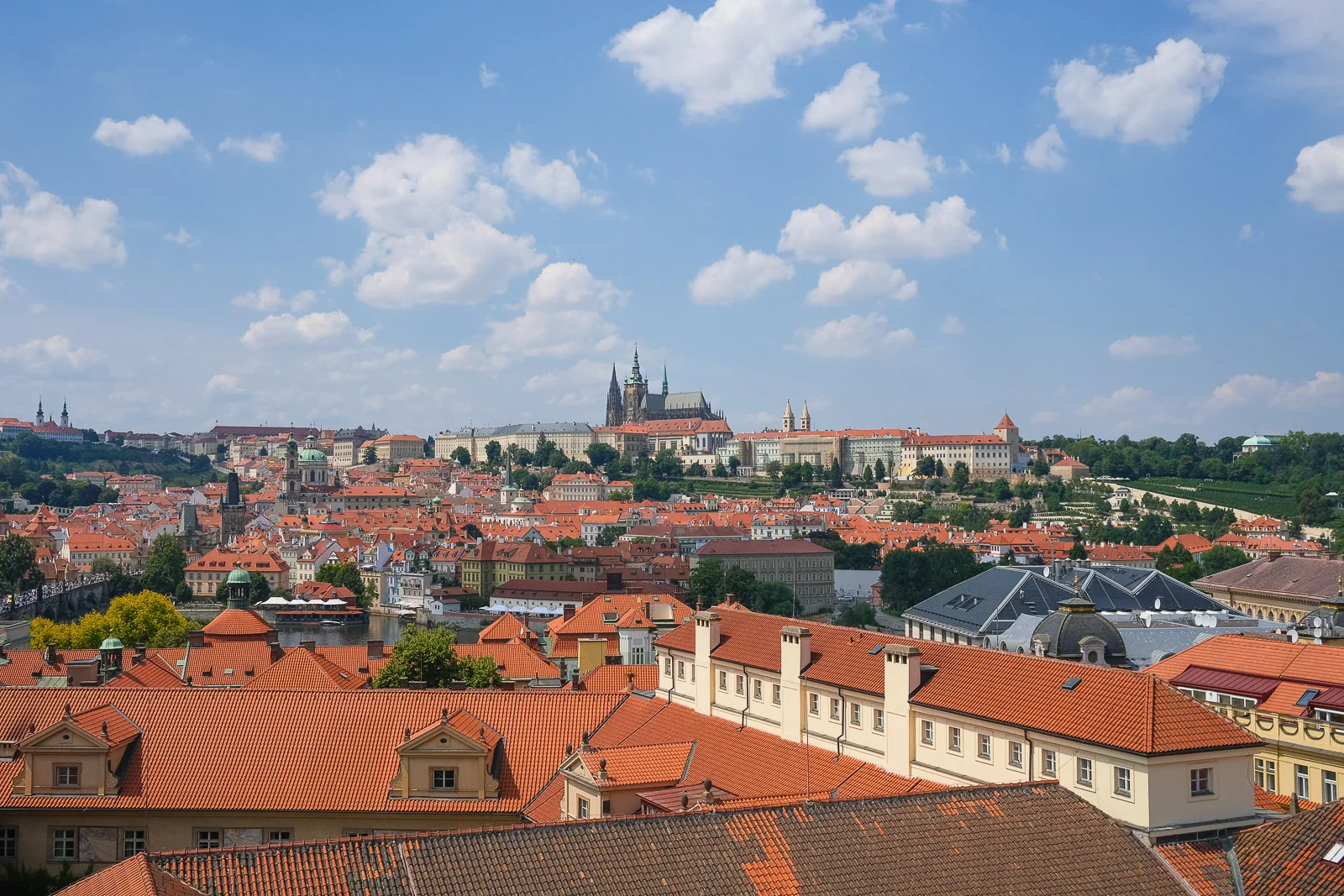
If you’re looking for your next getaway, Prague is the perfect city for a 3-day weekend. From exploring Prague Castle and crossing the iconic Charles Bridge to wandering the colorful lanes of Malá Strana or enjoying a traditional pastry on a lively square, the Czech capital is full of gems around every corner. Romantic and vibrant, at the crossroads of Gothic, Baroque and Art Nouveau influences, Prague wins over culture lovers and seasoned wanderers alike. We definitely fell under its spell!
So what should you do in Prague in 3 days? Where should you stay, where should you eat and what budget should you plan for? We tell you everything in this article about a city we loved. Follow the guide!
Our 3-day Prague itinerary
Here’s a summary of our Prague itinerary, which let us see a lot of places, all organized in a logical order to keep travel time to a minimum:
- Day 1: Old Town (Astronomical Clock, Clementinum), Josefov (Jewish cemetery, synagogues), Charles Bridge, Letná Park and a concert at the Municipal House.
- Day 2: Prague Castle, Strahov Monastery, Malá Strana, Kampa Island and Střelecký Island.
- Day 3: Mucha Museum, an Art Nouveau walk through Nové Město, the Church of Saints Cyril and Methodius and the Vltava embankment.
To follow this itinerary, the best option is to stay in a central neighborhood. We went with Hotel William, in Malá Strana, and it was perfect!
You’ll find all the places we visited on the map below:
Day 1: Old Town & Josefov
We start with Staré Město, Prague’s Old Town. This is the capital’s historic center, with medieval streets and a blend of architectural styles: Gothic, Renaissance, Baroque and Art Nouveau.
Prague’s Old Town Square
The best place to see this is Old Town Square (Staroměstské Náměstí). Some of the city’s most famous landmarks surround this huge square:
The Astronomical Clock
Prague’s signature landmark! Built in 1410, it’s the oldest astronomical clock still in operation. The upper dial shows the time in 3 different time systems as well as the cycles of the moon and sun. The lower dial shows the saints’ days and the signs of the zodiac.
Every hour, the clock comes to life for a (very) short show that draws crowds, as its figures start moving and the twelve apostles parade past the windows.
The clock is mounted on the tower of the Old Town Hall, which you can climb for a view over all the monuments of the Old Town. We gave it a try, and it really does give you some perspective over this often-packed square. We recommend booking your tickets in advance!


Church of Our Lady before Týn
This imposing Gothic church dominates the square. Easy to recognize by its two towers, nicknamed Adam and Eve, Our Lady before Týn was built between 1365 and 1470 and holds the tomb of the famous astronomer Tycho Brahe.


St. Nicholas Church
This other church, in Baroque style, is well worth stepping into. The interior is stunning, covered in paintings from the walls to the ceiling. We loved it! You’ll also find a monumental chandelier weighing over 3,000 pounds (1,400 kg).
Don’t miss the square’s other points of interest either, like the statue of reformer Jan Hus, the Prague meridian and the decorated facades of the House at the Minute and the Štorch House.


Clementinum
Founded in 1556 by the Jesuits, the Clementinum (“Klementinum”) is a huge complex, the second largest in Prague after the castle. It was built over thirty houses, 3 churches, 10 courtyards and several gardens, covering about 5 acres (2 ha)!
Of course, only a few buildings are open to visitors today, but they’re stunning, including the famous National Library of the Czech Republic, which is worth the trip on its own. We wish we could have walked among the magnificent globes and countless books, but these restrictions are in place to preserve the site.
After a few flights of stairs, you can also reach the top of the Astronomical Tower, which offers an exceptional 360° panorama over Prague: Charles Bridge and the Vltava, the Church of Our Lady before Týn and Prague Castle, among others.
Finally, the Mirror Chapel on the ground floor is only open for concerts (tip: ask nicely at the front desk if you can take a peek at this superb room!).
The Clementinum can only be visited on a guided tour (in English or Czech), which is a great way to learn more about this iconic Prague landmark. We recommend it!
Practical information:
💵 Price: $18, book at least one day ahead here.
🕘 Opening hours: Daily from 9 a.m. to 7 p.m. (8 p.m. from April to September)
⏳ Time needed: 1 hour


Josefov, the old Jewish Quarter
Next, head to the north of the Old Town to discover Josefov, Prague’s former Jewish Quarter, named after Emperor Joseph II. In the 16th and 17th centuries, Josefov was one of the largest ghettos in the world, with nearly 11,000 residents. Today, the neighborhood is very touristy, and there’s a lot to see on a stroll!
To visit the neighborhood, you’ll need the Jewish Quarter ticket (also called the Jewish Museum ticket), which gives you access to the cemetery and the four synagogues for CZK 600 (about $27). There’s no way to visit them individually anyway. Note that these sites are closed on Saturdays.
Prague’s Old Jewish Cemetery
Dating back to the 15th century, this impressive Jewish cemetery is the resting place of up to 100,000 people. Due to lack of space, the tombstones are piled on top of one another, giving the place an unusual, mysterious atmosphere.
We recommend coming early so tour groups don’t spoil the experience. Don’t miss the tomb of Judah Loew ben Bezalel, known as Rabbi Loew, creator of the Golem according to legend.
Right next to the cemetery is the Pinkas Synagogue. It’s home to the Memorial to the 80,000 Victims. The names of the Jews of Bohemia and Moravia who died in the Holocaust cover every wall, along with their dates of birth and death. It’s a dizzying and moving tribute, given the sheer number of names you can sadly read there.


The synagogues of the Jewish Quarter
Old-New Synagogue: Built around 1270, it’s the oldest active synagogue in Europe, having survived the fires and floods that hit the Jewish town. The interior is very plain. It sits below today’s street level, as its floor marks the street level of the time.
Spanish Synagogue: The most beautiful synagogue in the Jewish Quarter! With its interior entirely covered in gilded Moorish stucco, it took our breath away when we walked in. Beyond its undeniable beauty, the Spanish Synagogue also hosts an interesting exhibition on the history of the Jews of Bohemia and Moravia. Next to the synagogue entrance, don’t miss the Franz Kafka statue by sculptor Jaroslav Róna.
Maisel Synagogue: This other beautiful synagogue holds the second part of the exhibition on Jewish history. Maiselova Street, where it’s located, is also worth a look for its many Art Nouveau buildings.

Pařížská Avenue
This avenue is a bit like Prague’s Champs-Élysées. Pařížská Avenue (Paris Avenue) cuts the Jewish Quarter in two, with a superb view stretching from Letná Park and its giant metronome all the way to Old Town Square. Luxury boutiques line the street, but if you look up past the shop windows, you’ll see a whole row of tall Art Nouveau buildings.


Convent of St. Agnes of Bohemia
At the other end of Josefov, away from the usual tourist trail, you’ll find the peaceful, charming neighborhood built around the Convent of St. Agnes. The houses are low (it’s home to the smallest house in the city) and the lanes are narrow. The convent and its garden are a little haven of peace. The Gothic church is worth a look, with an exhibition of medieval art and occasional concerts.
Charles Bridge
This is probably the most iconic spot in Prague! Charles Bridge (“Karlův Most”), 1,693 feet (516 m) long, links Staré Město to Malá Strana, and for a long time it was the only bridge in Prague.
Crossing Charles Bridge is when you really grasp how beautiful Prague is, with views of the castle, the Vltava and the colorful buildings of Malá Strana. Crossing it can easily take thirty minutes, between snapping your favorite photos, looking at the many statues lining both sides of the bridge, watching the caricaturists at work and admiring the towers at each end.
Our tip: come early at least once (between 8 and 9 a.m.) to enjoy a bit of peace and quiet. After those early hours, it gets very crowded, but that doesn’t take away (too much) from its charm.


Letná Park
With the July heat, we decided to get away from the city center for a walk in the green. We headed to Letná Park, with its 104 acres (42 ha) of greenery and a pond where we could dip our feet. Julie, who visited Prague in the fall of 2017, also recommends the park in that season: the foliage colors are gorgeous!
The other reason we came to Letná is the view over Prague and the city’s string of bridges. It’s a view that stuck with Julie back then, and she was determined to see it again. If you love panoramic views like we do, it’s well worth the detour.
We also discovered the giant metronome that replaced the old Stalin Monument, once one of the largest statues in Europe! We tell you more about it in our article on unusual things to do in Prague.

Concert at the Municipal House
We ended this great first day with a concert at the Municipal House. On the program: Vivaldi’s Four Seasons, Mozart’s Queen of the Night aria and pieces by Czech composer Dvořák, all in a sumptuous setting. We liked how accessible the program was: we’d heard most of the pieces at least once before (you can find a video clip in our “Prague” story highlight on Instagram).
We highly recommend this activity, or at the very least a visit to this magnificent building in the Art Nouveau (or Secession) style. Its facade is stunning, and so is the café inside. It also has a room painted by artist Alfons Mucha, the Mayor’s Hall, which unfortunately can only be seen on a guided tour.


Day 2: Prague Castle and Malá Strana
Day two is all about the other bank of the Vltava, with Malá Strana and the famous Prague Castle as the highlights.
Prague Castle and St. Vitus Cathedral
These two landmarks, among Prague’s most iconic, are visited together, since the cathedral sits within the castle grounds. Entry costs CZK 450 (about $20). But as a victim of its own success, the line to buy tickets can be very long. We recommend arriving at opening time or, like us, going for a skip-the-line ticket!
Once you have your ticket, you can visit several sites:
The Old Royal Palace: The tour of the castle interiors is fairly short, as few rooms are open to the public. Still, we were impressed by the huge 203-foot-long (62 m) Gothic banquet hall. You can explore a few other rooms, including one decorated from floor to ceiling with the coats of arms of noble families of the time, and the one where the defenestration of the nobles took place, which sparked the Thirty Years’ War.
St. Vitus Cathedral: This imposing Gothic cathedral almost looks squeezed in, hemmed into the castle’s second courtyard. Inside, take time to see all the beautiful chapels. We fell in love with the magnificent, one-of-a-kind stained-glass window by Alfons Mucha. You’ll also see the huge silver tomb of St. John of Nepomuk. For an extra $9 or so, you can climb to the top of the cathedral’s south tower.
St. George’s Basilica: An elegant Romanesque basilica whose pink facade hides the crypt of the kings of the Přemyslid dynasty.
Golden Lane: This typical 16th-century lane was home to the goldsmiths and gold beaters who gave it its name. Kafka also stayed here on several occasions. You can see re-creations of the houses as they once were: a tavern, a craftsman’s workshop and even a fortune teller’s parlor.
The gardens on the ramparts: Accessible from the castle’s third courtyard, these gardens offer a lovely view of Charles Bridge and Prague’s different neighborhoods.
On Castle Hill, you can also visit the Royal Garden and the Stag Moat, Rosenberg Palace, the Black Tower and the Mihulka Powder Tower, and Lobkowicz Palace.


Strahov Monastery
Strahov Monastery is home to two magnificent libraries, the Theological Hall and the Philosophical Hall, which are every bit as impressive as the Clementinum’s. One of the ceilings is covered with a fresco depicting nothing less than the history of humanity.
The two libraries are connected by a surprising cabinet of curiosities, filled with animal skeletons, model ships and precious stones. The cloister also houses an art gallery, which we didn’t visit.
Just steps away, you’ll find the Strahov Monastery Brewery, where you can taste the beer brewed on site and maybe grab a bite (the monks know their way around an apple strudel too)!
Practical information:
💵 Price: $9 for the libraries only, $16 including the cloister gallery, book here.
🕘 Opening hours: Daily from 9 a.m. to 5 p.m.
⏳ Time needed: 30 minutes to 1 hour


Petřín Hill
Petřín Hill is the huge park overlooking the Vltava, a short walk from Prague Castle. Completely free, it’s worth the detour for its lovely views of the city and the bridge. It’s very peaceful, and you can easily find yourself alone among the trees.
This hill is also home to the famous Petřín Lookout Tower, visible from all over Prague. This copy of the Eiffel Tower, about 200 feet (60 m) tall, was built for the 1891 Jubilee Exhibition. You can climb it for a view over the city, for CZK 250 (about $11). Next to the tower is the Mirror Maze, another popular attraction that kids will love.


Malá Strana
After your walk on the hill, continue with a stroll through the heart of Malá Strana. Founded in 1257 at the foot of the castle, it’s one of the oldest neighborhoods in the Czech capital. On the menu: pretty squares and cobblestone streets, historic homes and beautiful mansions. We suggest starting by walking down Nerudova Street.
Nerudova Street
This is one of the most beautiful streets in Prague, and it has kept its historic atmosphere almost intact. Look at the facades of the houses along it and you’ll notice all kinds of house signs: three violins, a big turnip or a golden key. These signs showed the trade of each house’s residents and served as landmarks before the streets were numbered.
Wallenstein Garden
These beautiful free gardens belong to Wallenstein Palace, home to the Czech Senate. Separated from the city by a high wall, they’re a little haven of peace (all the more so since they’re much less touristy than other places in Prague).
Clipped hedges, rows of bronze statues and ponds: you’d think you were at Versailles. The back wall, nicknamed the Dripstone Wall, is a real curiosity that looks ready to drip onto visitors. And the icing on the cake: we even spotted an albino peacock!


The John Lennon Wall
Located near the French Embassy, the John Lennon Wall has become a must-see photo spot in Prague. Students painted this colorful wall in the 1980s as a symbol of freedom and opposition to the communist regime. Since then, it’s regularly covered with new paintings and graffiti.
Right next to the wall, don’t miss the pretty water mill and Kabourek, the goblin statue that watches over it.

Kampa Island
Right next to the John Lennon Wall is the lovely Kampa Island, bordered by the Vltava River and the Čertovka stream. Even though it sits right next to Charles Bridge, it’s remarkably peaceful.
On the island is Museum Kampa, actually a private foundation dedicated to modern and contemporary art, especially artists who were banned from exhibiting under the communist regime (we didn’t visit it). At the museum entrance, you can’t miss the giant baby statues by artist David Černý, called “Babies,” said to criticize capitalist society and modern education. Right next to them are the 34 yellow penguins made from plastic bottles by the Cracking Art Group to raise awareness about global warming and melting ice. We wrapped up this part of the visit at the pretty, colorful and shady Na Kampě square.


Střelecký Island
To end this packed day, head to another of Prague’s islands: Střelecký Ostrov. Almost in the middle of the Vltava, this island is a big green park that’s perfect for a stroll, with an open-air food court for a drink or a bite. We gave in to a drink while listening to live music, watching the many pedal boats drift around the island and admiring the magnificent view of the Old Town and Charles Bridge. It was one of our favorite spots in Prague! Note that we’re not sure the food court is open year-round.


Day 3: Nové Město
We wrap up our exploration of Prague with Nové Město, the New Town. One of the largest districts in the city, it’s a vibrant witness to the capital’s more recent history.
Mucha Museum
This museum is dedicated to Czech Art Nouveau painter Alfons Mucha. You discover the artist through summaries of his life and through his works. He’s world-famous for his advertising posters, especially for plays (like Gismonda, starring Sarah Bernhardt) and companies like Lefèvre-Utile (LU cookies). Original posters are of course on display in the museum, and they’re all gorgeous. Mucha also devoted a large part of his life to The Slav Epic, a series of 20 huge canvases (1910–1928) tracing the history, myths and culture of the Slavic peoples. With this monumental work, he wanted to glorify the history and unity of the Slavic peoples and revive their national pride.
Besides being interesting without being too long, the museum is really beautiful. We highly recommend it!
Practical information:
💵 Price: $13
🕘 Opening hours: Daily from 10 a.m. to 6 p.m.
⏳ Time needed: About 1 hour


Art Nouveau walk
Nové Město is full of beautiful buildings in the Art Nouveau, or Secession, style. To see them, follow this north-to-south route from the Powder Tower to the National Museum.
Start with the gorgeous Café Imperial. The walls are entirely covered in mosaics, like an Egyptian temple. One small downside: the menu is a bit pricey, so we just had an espresso!
Next up is the K+K Hotel Central Prague, straight out of The Grand Budapest Hotel with its superb facade and classic Art Nouveau lettering.
Then head to Prague’s main train station. On the way, don’t miss Henry’s Tower and the very colorful facade of the Jubilee Synagogue. Completed in 1909, the station is Prague’s second-largest Secession building after the Municipal House. It stands out for its impressive, richly decorated dome.
Keep going with the administrative buildings, starting with the Czech Post headquarters. Behind a rather plain facade lies a huge hall with a glass ceiling and fully painted walls.
The walk continues through Nové Město’s covered arcades, starting with Koruna Palace. The building’s facade is imposing, with its corner tower and dome held up by atlantes. Its arcade takes you under a glass dome. Another arcade worth seeing is Lucerna Palace. The passage is beautiful, and it’s home to David Černý’s funny statue of Saint Wenceslas riding his horse upside down.
Opposite the Lucerna Passage, don’t miss the beautiful Secession facade of the Grand Hotel Europa. Turn south and you’ll see the National Museum at the far end of Wenceslas Square, one of the largest squares in Europe. We didn’t visit the National Museum, but it’s said to be worth it, as much for its collections as for its architecture.
Closer to the Vltava, don’t miss the beautiful side-by-side facades of the Topič Salon and the Pojišťovna Praha building.


The rotating Head of Franz Kafka
Probably the best-known sculpture in Prague, by David Černý. It depicts the head of Czech author Franz Kafka. The statue rotates on itself every hour on the hour and ripples every half hour.
You’ll find other works by David Černý all over the capital. Close to the Kafka head, you can see the Hanging Man, the Spitfire butterflies on the facade of the huge LEVELS arcade, and the three figures on the roof of Deym Palace.


Church of Saints Cyril and Methodius
This fairly plain church is dedicated to the two “Apostles to the Slavs,” Cyril and Methodius. But what’s really worth the visit is in its crypt. This is where the paratroopers of Operation Anthropoid, which led to the assassination of Reinhard Heydrich (acting Reich Protector of Bohemia and Moravia) in 1942, hid before being besieged by the SS.
A free exhibition in the crypt covers the details of the operation and its consequences.


Dancing House
The Dancing House (Tančící dům) was designed by Czech architect Vlado Milunić and American architect Frank Gehry. It owes its name to its very unusual deconstructivist shape, which makes the building look like it’s being sucked into a vortex.
The building isn’t open for tours, but you can take the elevator to the 7th floor, home to the Glass Bar and its panoramic terrace (terrace entry costs about $7).

Walk along the Vltava embankment
We end our tour of Nové Město with a walk along the Vltava embankment. The buildings lining the river are gorgeous, a row of colorful facades, each more elegant than the last.
The stretch of embankment between Palacký Bridge and the Výtoň stop is also worth the detour. It’s lined with bars and cafés built into niches in the wall, each with a huge porthole. Bike7, LAb, Kobka6: you’re sure to find a spot you like to end the day!

Take a cruise on the Vltava
If you’d rather rest your legs after this long day of walking, you can also go for a cruise on the Vltava.
You can do it during the day or, even better, at sunset to watch Prague’s landmarks, like Charles Bridge and the Straka Academy, light up. Many operators offer tours to see the city from the river during golden hour. Cruises usually last 50 minutes and cost between $16 and $22 depending on the operator.
Charles Bridge at night
Before leaving Prague, we wanted one last look at Charles Bridge and the Old Town by night. At sunset, the atmosphere is completely different. The crowds thin out and the streets get some of their calm back. Once night falls, Prague Castle lights up, much to our delight.


Where to stay in Prague for 3 days
Prague has no shortage of places to stay! Our main tip is to stay in a central neighborhood. We went with Malá Strana, on the castle side, since Old Town prices had shot up in summer.
We stayed at Hotel William, which let us stay in a lovely hotel and neighborhood without breaking the bank, 5 minutes from Charles Bridge, with breakfast included.
To get an idea of accommodation prices in Prague, check out the map below:
Where to eat in Prague
There are tons of restaurants in Prague, and it’s easy to get overwhelmed by all the options or, worse, fall into a tourist trap. So here’s our pick of tried-and-tested places (we loved them all)!
Good to know: Tipping is very common in Prague. It’s often suggested, and leaving about 10% of the bill after a restaurant meal is appreciated.
You’ll also find all these places on the interactive map at the beginning of this article.
In the Old Town
🍽️ Restaurace Mincovna: Just steps from Old Town Square, this restaurant serves very good traditional dishes at perfectly reasonable prices.
🥟 U Parlamentu: A simple, no-fuss traditional restaurant. The potato dumplings are very good!
🍗 Tiskárna Jindřišská: Our favorite “traditional” spot. The local dishes are nicely presented, and the bread dumplings were delicious.
🥞 Venue: A brunch spot right next to Havelská Market. Thanks to the banana pancakes, we almost forgot to eat for three days.
🍨 Crème de la Crème: A little ice cream shop in the heart of the Old Town with classic but delicious flavors!
🧁 Little Chimney: Yes, we know, chimney cakes (or trdelník) don’t actually come from the Czech Republic. But we have a sweet tooth and wanted to try them too. The ones at Little Chimney are very good, and you can fill them with all sorts of things (ice cream, whipped cream or fresh fruit).
☕ Café Imperial: Mentioned in the Art Nouveau walk, this café is more of a treat for the eyes than for your wallet, but it’s worth a stop!
🧊 Grand Café Orient: This Cubist café is one of a kind. Everything inside is Cubist: the furniture, the decor, the architecture and even some of the cakes.
Near the castle and Petřín
🍳 Nerudova 211 Café: Below the castle, this café serves a very good brunch, with super friendly staff.
🍔 The Beer Spot Prague: A small local spot at the foot of Petřín Hill. In a lovely little courtyard, they serve very good food, including huge burgers.
🥦 Natureza Vegetarian House: A vegetarian alternative serving local dishes with a twist, in a super pleasant backyard.
🍦 Angelato: An artisan ice cream shop with original flavors, perfect for rewarding yourself after climbing Petřín Hill.
How much does a 3-day trip to Prague cost?
For our long weekend in Prague, we spent about $1,150 in total, or about $575 per person. Of course, this is only a rough guide and will vary a lot from one traveler to another. It also doesn’t include getting there, since we flew from Paris to Prague and then took a train on to Krakow.
For food, we ate out every day, with an afternoon snack or a drink in the evening (beer is really cheap). There are restaurants for every budget, but expect to pay around $11 to $17 per main course at the cheaper places.
For sightseeing and activities, most of the budget went to the castle, the Jewish Quarter and the concert at the Municipal House. Since the city is perfect for wandering, you can see lots of beautiful things without paying a cent.
For transportation, we mostly used the tram, which is efficient and cheap, and our own two feet! We only splurged on a ride-share from the airport when we arrived.
| Expense | Budget per person |
|---|---|
| Hotel | $228 |
| Restaurants | $150 |
| Sightseeing & activities | $134 |
| Snacks & drinks | $43 |
| Transportation | $21 |
| Total | $576 |
What currency is used in Prague?
The currency in Prague is the Czech koruna (CZK). 1 koruna = about $0.05.
You can withdraw or exchange korunas once you’re there, or pay with a bank card. To avoid extra costs, we recommend using a card with no foreign transaction fees, and always choosing to pay in korunas rather than in dollars when a card machine or ATM asks, as the exchange rate is otherwise much worse.
How to get around Prague
Prague is a city best explored on foot! The center isn’t very big, and the main sights are easy to reach on foot. That’s how you’ll spot the city’s beautiful Art Nouveau buildings or stumble upon a David Černý sculpture.
For longer trips, the public transportation network (tram and metro) works very well. It’s also a chance to ride the charming historic trams that run through the city (lines 41 and 42). The easiest way to buy tickets is through the PID Lítačka app. Expect to pay about $1.70 for 30 minutes. You can also buy 24-hour ($6.50) or 72-hour ($16) passes.


When is the best time to visit Prague?
Prague is a year-round destination. We visited in the middle of summer, in July, and even though it was busy and accommodation was pricier, we loved the city’s vibe at that time of year. The terraces are lively, the city is green, the days are long and pedal boats float on the Vltava, which adds a lot of charm.
In winter, around December, Christmas markets and decorations pop up all over the streets, creating a very special atmosphere. The city is still very touristy, but the vibe is quite different. Prague’s Christmas markets usually run from late November to early January. The biggest one is on Old Town Square, but there are others on Wenceslas Square (with an ice rink) and Republic Square. It’s the perfect chance to try svařák (local mulled wine) and vánočka (braided sweet bread)!
Every season has its pros and cons, so pick the one that appeals to you most!
How many days do you need in Prague?
We spent 3 full days in Prague, and they were packed! It let us see the whole city and do lots of visits. So we recommend at least 3 days if you want to follow the itinerary in this article.
If you can, staying 4 days or more lets you explore at a slower pace and add a few sights further afield.
Is the Prague City Pass worth it?
Like many tourist cities, Prague has its own city pass: a time-limited pass that gets you into a wide selection of sights. Prague’s is a pretty good deal, since it includes unlimited public transportation and the city’s major sights, such as:
- The Astronomical Clock tower
- The Clementinum
- The Jewish Quarter
- Prague Castle
- Petřín Lookout Tower
- A cruise on the Vltava
- Lots of viewpoints, like the Powder Tower and St. Nicholas Bell Tower
It costs $116 for 48 hours and $143 for 72 hours, which can quickly pay for itself if you plan on lots of visits!
You can book your pass ahead of time directly through this link.
More to see in Prague
If you’re planning an extra day in Prague or would rather explore the city’s museums, here are a few ideas to round out your trip:
- Vyšehrad: This historic fortress sits on a hill above the Vltava, south of Prague’s center. It has impressive ramparts, the Basilica of Saints Peter and Paul and a cemetery where many famous Czech figures are buried.
- National Museum (Národní muzeum): A cultural symbol of the city, it holds vast collections of natural history, Czech history and art, in an impressive Neo-Renaissance building on Wenceslas Square.
- Museum of Communism: This museum covers daily life, propaganda and repression under the communist regime, which lasted more than 40 years in Czechoslovakia.
- Franz Kafka Museum: This museum traces the life and literary world of the Prague-born writer, considered one of the most influential of the 20th century, with manuscripts, photos and immersive installations.
- National Technical Museum: This museum has collections of cars, locomotives and airplanes, plus exhibits on photography, astronomy, clockmaking and printing.
- Prague Zoo: Covering more than 120 acres (50 ha), this zoo is one of the most highly regarded in the world, with around 700 species, including some very rare ones like Przewalski’s horse, which the zoo helped reintroduce into the wild. The grounds mix flat areas and hills, with a chairlift up to the higher sections.
- Vrtba Garden: One of the finest examples of a Baroque garden, laid out in terraces with statues, symmetrical flowerbeds and decorated staircases. It offers superb views over Prague’s red rooftops and Petřín Hill.
Our 3 days in Prague: the verdict
We simply loved visiting Prague! We didn’t expect to like it this much, but it went straight into our top 3 cities. We found it truly stunning: colorful, full of panoramic views and filled with fascinating architecture, surprising statues and details. And when it comes to culture and history, we never got bored for a second. There’s so much to visit and learn in Prague. Whether you love wandering, learning or both, go for it!
Want more ideas? Check out our 12 must-see places in Prague and our 16 unusual things to do in Prague.
Some of the links in this article are affiliate links, which means we earn a small commission if you make a reservation through them. This doesn’t change the price for you, but it helps us continue to create content for our blog, which will always remain free. Thank you for your support 🫶