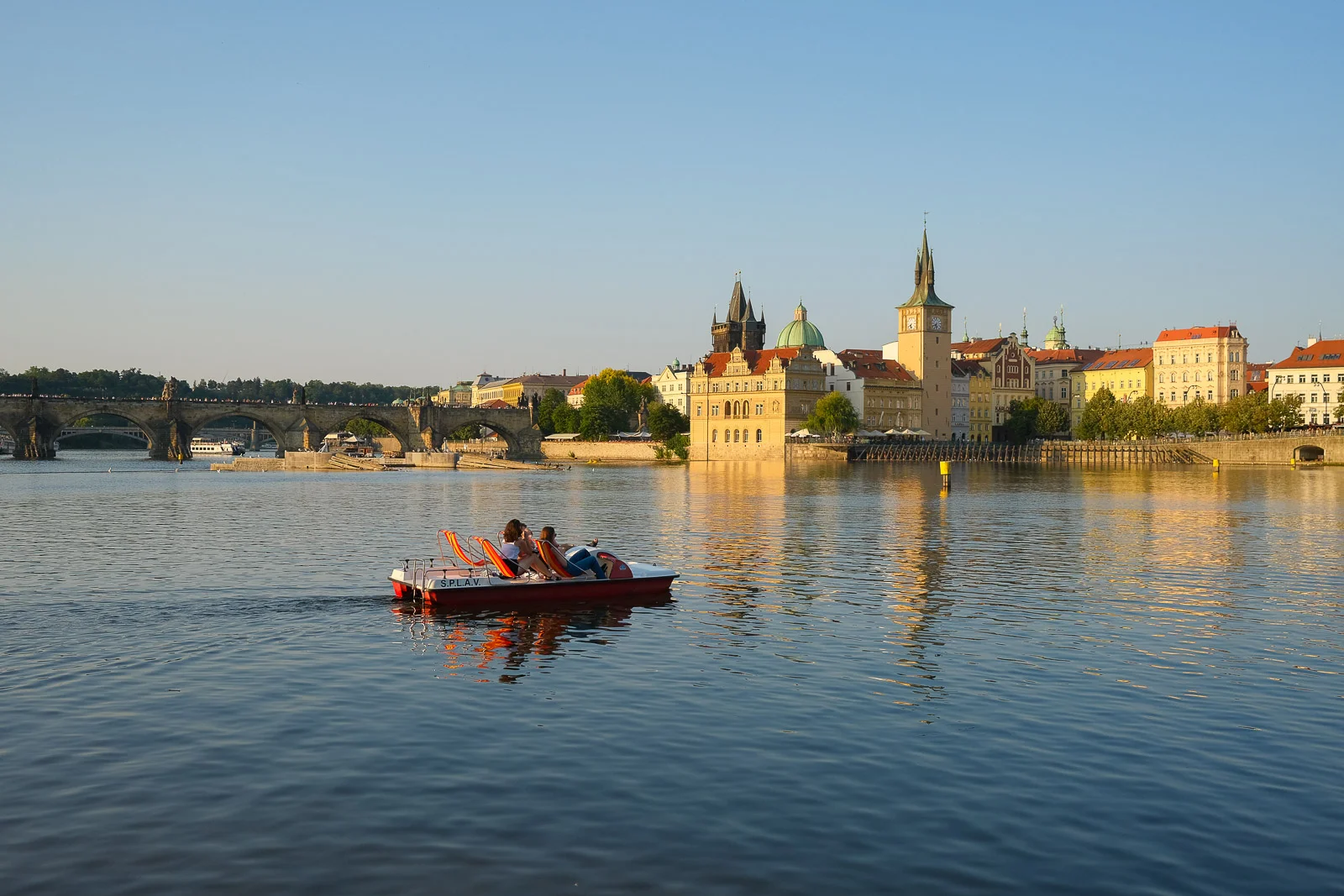
Prague may be famous for its castle, its astronomical clock and its $3 beers, but the Czech capital is also full of oddities and unusual places that are well worth a detour.
Absurd sculptures, characters from fairy tales and legends, out-of-the-ordinary architecture: here is our pick of 16 unusual and offbeat places to discover during a weekend in Prague!
1. David Černý’s strange statues
If one artist has left his mark on Prague, it’s David Černý. This surrealist Czech sculptor has scattered many sculptures across the public spaces of his hometown. Subversive and politically charged, these works are now very much part of Prague’s cultural heritage.
Among his best-known sculptures worth seeking out:
- The Head of Franz Kafka, whose 42 layers rotate every hour (and ripple around on themselves every half hour), powered by 21 motors. It’s a show that draws plenty of curious onlookers.
- Horse: a funny statue of Saint Wenceslas riding his horse upside down, hanging in the middle of the Lucerna Passage. A few yards away, on Wenceslas Square, you can see the more realistic version that inspired the artist.
- Butterflies: these giant butterflies with Spitfire bodies are a tribute to the Czechoslovak airmen who joined the Royal Air Force after the German invasion. Hanging on the wall of the LEVELS arcade, they’re hard to miss, especially when they start flapping their wings.
- Piss (or Proudy): set right in front of the Franz Kafka Museum, this statue shows two men facing each other, peeing on a map of the Czech Republic. If you’re lucky, you might even see their privates swing from side to side.
- Man Hanging Out: this one is easy to miss, since passersby on Husova Street have to look up to see a man, Sigmund Freud, dangling over the void.
- Babies: these strange babies, which you can see crawling around Kampa Park or climbing the Žižkov Television Tower, are rather unsettling with their missing faces.
- Deymův Palác: quirky lightbulb-headed figures have taken up residence on the facade of this pretty palace.
There are many more to discover in and around central Prague, like Lilith, Embryo, Trifot and London Booster. Time to go hunting for all of them!


2. The penguins of Kampa Island
Sticking with sculptures, check out the surprising yellow penguins marching single file on Kampa Island. These 34 yellow penguins, set on a metal walkway along the Vltava, are as adorable as they are alarming.
They were made from recycled plastic bottles by the Cracking Art Group to warn about the dangers of global warming and plastic consumption. And as a bonus, they light up after dark.


3. Prague’s only Cubist café
Czech Cubism is an art movement that left its mark on Prague in the early 20th century, in painting and sculpture but also in architecture.
One of the capital’s first Cubist buildings is the House of the Black Madonna, designed by architect Josef Gočár. It’s home to the Grand Café Orient, the only Cubist café in Prague.
Everything inside is Cubist: the furniture, the chandeliers, the balcony and even some of the desserts. It’s well worth a stop for a coffee break overlooking the little square below.
A little further on, you may also come across Emil Králíček’s Cubist lamppost, a one-of-a-kind curiosity.


4. The dripping wall of the Wallenstein Garden
The Wallenstein Palace Garden, free to enter, is a lovely haven of peace in the heart of Malá Strana. But what we’re interested in here is at the very back of the garden: the Dripstone Wall.
This wall is a strange sight. From afar, it looks like it’s made of faces dripping down onto visitors. It’s actually a surprising mass of stalactite-like rock formations. Signs along the wall point out that if you look closely, you can make out human and animal faces in its shapes.


5. The giant metronome in Letná Park
Towering over Letná Park at about 75 feet (23 m) tall, the bright red Prague Metronome can be spotted from far away. This surprising sculpture stands on the site of the Stalin Monument, a massive statue that ranked among the largest in Europe, built when Czechoslovakia was under Soviet control.
The Stalin statue was blown up in 1962, during de-Stalinization, leaving only its base. It wasn’t until 1991, after the fall of communism in the country, that the base got a new occupant. The motor-driven metronome was built to symbolize the passing of time.
We recommend heading up to the foot of the monument to enjoy the view over Prague and the laid-back atmosphere, among skateboarders and locals on dates.


6. The house signs of Nerudova Street
Before house numbers became the standard way to find your way around Prague, houses had signs, usually showing what the residents did for a living. You can find them all over Prague’s old neighborhoods, but Nerudova Street, just below Prague Castle, is where you’ll see the most.
Here, three violins show that the house belonged to a family of violin makers, while a golden key or a chalice point to former goldsmiths. There are also more whimsical signs, like a red lion, a green lobster, or two suns above the house where Czech writer Jan Neruda, after whom the street is named, used to live.


7. Kabourek, the water goblin
In Malá Strana, a stone’s throw from the John Lennon Wall, you’ll find a pretty water mill on the Čertovka, the “Devil’s Stream.” But what we’re after is right next to it: the statue of Kabourek, a funny creature that’s not quite human.
He’s a vodník, a creature from Czech folklore, somewhere between a frog and a water goblin. According to Prague legend, forty of these goblins live in the Vltava. Kabourek is said to be one of them, and once helped fishermen find fish in exchange for tobacco. Sculptor Josef Nálepa created the character in 2010 in response to tourists’ annoying habit of hanging padlocks on every bridge in the neighborhood. So this goblin is there to keep them in line!

8. The porthole bars on the Vltava
If you walk along the Vltava embankment between Palacký Bridge and the Výtoň stop, you’ll pass huge portholes hiding a series of small bars. Bike7, LAb, Kobka6: these little bars tucked right into the embankment look great with their pivoting portholes (the largest single-hinge windows in the world).
These former 19th-century storage spaces were recently turned into hangout spots by the city of Prague. In summer, they’re all buzzing, with terraces spilling out onto the riverbank and the neighboring boats.


9. The libraries of Strahov Monastery
Founded in 1143, Strahov is the second-oldest monastery in the city. But what really draws visitors are the two magnificent libraries it houses: a Baroque Theological Hall and a Philosophical Hall. Tens of thousands of volumes are kept here, beneath two entirely painted ceilings.
Between the two libraries, you’ll also find a lovely cabinet of curiosities with the remains of a dodo, all sorts of surprising animals and insects, rare minerals and even a xylotheque: a collection of wood samples carved to look like books.
And don’t miss a taste of the local beer from Strahov Monastery at the brewery right next door!


10. Prague’s never-stopping paternoster elevators
Paternoster elevators, once fairly common in Europe, are doorless elevators in constant motion that never stop at floors, so riders have to hop on and off quickly. Safety rules have since banned new ones from being built, but a few are still running in Prague, and you can watch them or even ride them.
There are several, including in the Lucerna Passage and at City Hall, but they’re often closed to the public or only accessible on a guided tour. We tried our luck at the Palace YMCA, but the paternoster was under maintenance when we visited.

11. The stunning hall of Prague’s main post office
No architecture tour of Prague is complete without a stop at the Czech Post headquarters. Behind a plain-looking facade lies a huge hall with a glass ceiling and walls decorated by artist Karel Vítězslav Mašek.
This Neo-Renaissance building has been declared a Czech cultural monument. A free exhibition space upstairs gives you a view down onto the main hall.

12. The meridian on Old Town Square
Between the astronomical clock, the Church of Our Lady before Týn and all the other monuments on Old Town Square, this one is easy to miss. To spot it, you’ll have to look down at your feet.
For nearly three centuries, from 1652 to 1918, time in Bohemia was set by the Prague meridian. A column stood on the square, and every day its shadow fell at exactly noon right on the meridian. The column is gone, but the meridian line is still visible. Facing the Jan Hus Memorial, look for a brass strip with an inscription in Czech that reads “Meridian by which Prague time was once set.”


13. Idiom, the infinite tower of books
This infinite tower of books will delight book lovers and photographers alike. Artist Matej Krén used 8,000 books to create it, along with mirrors that give the illusion of infinity.
Installed in the entrance hall of the Prague Municipal Library in 1998, the work was an instant hit. Today, you’ll need to be ready for a long line if you want to peek inside the tower. Otherwise, you can easily skip the line and simply admire the installation from the outside.
14. The crypt of the Church of Saints Cyril and Methodius
The Church of Saints Cyril and Methodius is an 18th-century Orthodox church, but it’s best known for its role during World War II.
In June 1942, it sheltered seven Czechoslovak paratroopers involved in the assassination of top Nazi official Reinhard Heydrich, as part of Operation Anthropoid. After a fierce assault by SS troops trying to drive them out of the crypt, the resistance fighters were killed or took their own lives to avoid capture.
The crypt is now a free museum about this episode of the war and its impact on the conflict, as well as a memorial to the paratroopers.


15. The tomb of the Golem’s creator
In Prague’s Old Jewish Cemetery, where some 12,000 tombstones are piled on top of one another, one stands out. This is where Rabbi Judah Loew ben Bezalel, the central figure of the Golem legend, is buried, beneath a sand-colored tombstone decorated with a lion.
Known as Rabbi Loew, this 16th-century figure is closely tied to the city of Prague. Legend has it that he created the famous Golem, a creature made of clay, to protect the Jews of the Prague ghetto from pogroms. His story is said to have inspired many writers, from the Brothers Grimm to Mary Shelley and her Frankenstein.
Today, his grave is a place of remembrance, but also the perfect spot to make a wish. The pebbles placed on his tombstone actually cover scraps of paper on which people have written their wishes.

16. The narrowest street in the city
A short walk from the Franz Kafka Museum, you’ll stumble upon another oddity: a pedestrian street with its own pedestrian traffic light. It’s actually Vinárna Čertovka, the narrowest street in Prague.
At about 20 inches (50 cm) wide, only one person at a time can squeeze through. There isn’t enough room for two people to pass each other, which is why a traffic light was installed at each end of the street.
And if Prague’s little things are your thing, don’t miss the smallest house in the city. Next to the Convent of St. Agnes of Bohemia, you’ll recognize it by its official plaque and green paint!


Our practical tips for your trip to Prague
Where to stay in Prague?
The easiest option is to stay in a central neighborhood. We chose Malá Strana, on the castle side of the river, since prices in the Old Town are higher. We recommend Hotel William, a charming hotel in a lovely neighborhood that won’t break the bank, 5 minutes from Charles Bridge, with breakfast included.
Is the Prague City Pass worth it?
Prague has a city pass that includes unlimited public transportation and entry to the main sights (the castle, the astronomical clock, the Jewish Quarter, a Vltava river cruise and more). At $116 for 48 hours or $143 for 72 hours, it quickly pays for itself if you plan on lots of visits, and you can book it online ahead of time.
How many days do you need in Prague?
We spent 3 packed days in Prague, which was enough to see the city’s highlights and follow our itinerary. If you can, plan 4 days or more to explore at a slower pace and venture further out.
How to plan 3 days in Prague?
You’ll find our 3-day Prague itinerary in this article, designed to keep travel time to a minimum and see as many sites as possible. It covers the Old Town and Josefov on day one, the castle and Malá Strana on day two, then an Art Nouveau walk through Nové Město and along the Vltava on day three.
What about you? What unusual places have you discovered in Prague? Come share them with us on Instagram! To go further, check out our pick of Prague’s must-see places.
Some of the links in this article are affiliate links, which means we earn a small commission if you make a reservation through them. This doesn’t change the price for you, but it helps us continue to create content for our blog, which will always remain free. Thank you for your support 🫶