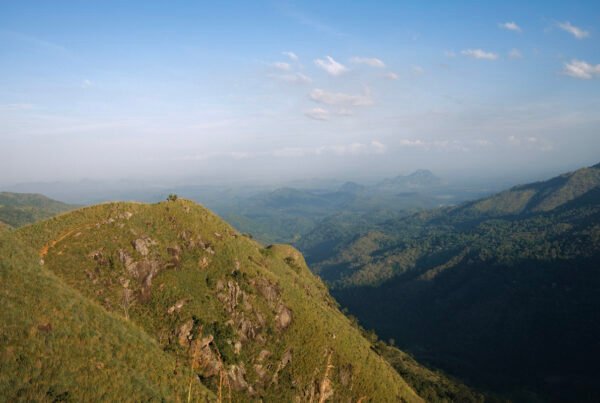
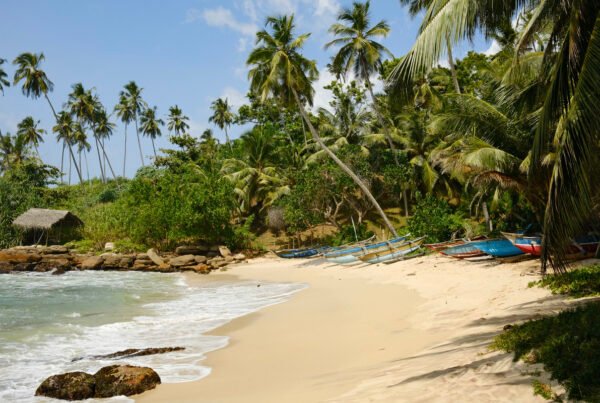
Exploring the beaches and jungle of Sri Lanka on a road trip of just over two weeks was a real highlight for both of us. Between safaris in the national parks, the ruins of ancient civilizations in the Cultural Triangle, mountain hikes surrounded by tea plantations, the iconic blue train from Kandy to Ella (one of the most beautiful train rides in the world) and surfing on the dreamy beaches of the south, Sri Lanka is a country packed with experiences, culture and scenery.
So why should you consider a road trip in Sri Lanka for your next vacation? And which itinerary should you choose? We tell you everything in this article!
📍 Our itinerary at a glance:
14 days for about $1,780 per person (flights from Europe included)
7 stops: Sigiriya > Kandy > Ella > Tangalle > Mirissa > Galle > Colombo
Trip taken in July 2023, article updated in November 2026 (prices, schedules, etc.)
Our 2-week Sri Lanka itinerary
Here’s our 2-week Sri Lanka itinerary in detail. It let us see a large part of the island without rushing, and it’s easy to do by public transportation.
- Arrival at Colombo airport (near Negombo)
- Sigiriya: 3 days
- Kandy: 1 day
- Ella: 2 days
- Tangalle: 4 days (including 1 day in Udawalawe)
- Mirissa: 1 day
- Galle: 1 day
- Colombo: 2 days

Sigiriya (3 days): History and jungle in the Cultural Triangle
🚌 Getting there: 2.5 hours by private car from the airport
⏰ Recommended time: At least 3 days, maybe 4 if you add Anuradhapura
📝 Full guide: Sigiriya and the Cultural Triangle: Our 3-Day Travel Guide
Where to stay in Sigiriya
We recommend Sigiri Forest View, a charming guesthouse run by Nandana and his family, just a short walk from Pidurangala Rock.
Our tips for exploring the Cultural Triangle
Sigiriya sits right in the heart of Sri Lanka’s Cultural Triangle, the area between the cities of Anuradhapura, Polonnaruwa and Kandy. This region is home to the remains of ancient civilizations and tells a big part of the country’s history. Since Sigiriya is right in the middle of the Triangle, it’s the perfect base for exploring the region.
Our favorite was the climb up Pidurangala Rock. It’s quick (30 minutes) and offers a stunning view over the Sigiriya jungle and Lion Rock, perfect at sunset. A UNESCO World Heritage Site, Lion Rock itself is a must-see, with its palace-fortress perched about 650 feet (200 m) up on a gigantic orange rock.
Around Sigiriya, don’t miss the Golden Cave Temple in Dambulla, with more than 150 statues spread across 5 caves, or the ancient city of Polonnaruwa, the ruins of a former capital of Sri Lanka, which is well worth a full day.
We share all the details of our stay in the Cultural Triangle in our full guide.
👉 Our full guide to Sigiriya and the surrounding area


Kandy (1 day): The Temple of the Tooth and a traditional market
🚌 Getting there: From Sigiriya, 2.5 hours by bus
⏰ Recommended time: 1 to 2 days, depending on your interests
📝 Full guide: Kandy Travel Guide: How to Spend a Day in Sri Lanka’s Cultural Capital
Where to stay in Kandy
We recommend Gruhaya Boutique Villa, where we spent one night, close to Kandy Lake in the quiet part of town. Otherwise, you can choose Café Aroma Inn, close to the city center, or Sevana City Hotel, closer to the train station.
Our take on Kandy
Kandy is one of Sri Lanka’s main cities and the starting point of the famous blue train to Ella. While the city has a few interesting sights, it wasn’t a favorite for us, so if you’re short on time, you can move straight on to the next stop!
We visited the Temple of the Sacred Tooth Relic, one of the holiest sites in the country. We also really enjoyed walking around the huge man-made lake right in the city center, and getting lost in Kandy Market, as beautiful as it is intense.


Ella (2 days): Hikes and tea plantations in the heart of the island
🚌 Getting there: From Kandy, 6.5 hours by train (see the 2026 update above)
⏰ Recommended time: 2 days, maybe 3
📝 Full guide: The Ultimate Ella Guide: Little Adam’s Peak, Nine Arch Bridge and Tea Country
Where to stay in Ella
There are lots of hostels in Ella, and we tried Hangover Hostels Ella, a few minutes’ walk from the town center, in a private air-conditioned room. But if you’d rather stay in a more classic hotel, we recommend Blooming Rose Ella and V@Ella Guesthouse, both with a stunning view over the Ella valley.
Things to do in Ella
Ella is a small, very touristy town in the mountains, where people come for the lush green scenery, beautiful viewpoints and Sri Lankan tea culture. And to get there, you take the famous blue train through the Sri Lankan countryside! The ride is truly stunning and the 6 hours fly by, but it takes a bit of planning. We share all our tips for planning your train ride in Sri Lanka in this article.
There’s no shortage of things to do in Ella: hikes up Little Adam’s Peak and Ella Rock, waterfalls like Ravana Falls, tea plantations and more. And you can’t miss the Nine Arch Bridge, the majestic stone bridge the train runs across. A stop in the middle of nature that did us a world of good!


Tangalle (3 days): Sri Lanka’s most beautiful beaches
🚌 Getting there: From Ella, 3 hours by bus
⏰ Recommended time: At least 2 days to explore the coast + 1 day for a safari in Udawalawe
📝 Full guide: Tangalle Travel Guide: Beaches, Safaris and Surfing in Southern Sri Lanka
Where to stay in Tangalle
We can’t recommend our hotel enough: Hidden Garden, right across from Tangalle beach. It’s run by a really friendly, attentive family who helped us rent a scooter to explore the area and made us the best breakfasts of our whole trip. Not to mention the pool and the big garden.
Our tips for exploring Tangalle
Tangalle is the perfect base for exploring the island’s south coast. And after 7 days trekking through Sri Lanka’s jungle and mountains, we were happy to unpack our bags and dig our toes into the sand!
There’s no shortage of beaches around Tangalle: Madilla Beach, Silent Beach, Blue Beach Island, Goyambokka Beach and more. But our favorite was Hiriketiya Beach, a perfect spot for swimming, and even for learning to surf with one of the surf schools there! Beyond the beaches, Tangalle also has the beautiful Rekawa Lagoon and mangroves you can explore by kayak. It’s one of our favorite areas in the country, and we loved hopping from beach to beach around Tangalle.


Udawalawe (1 day): A safari to see the elephants
Going on a safari to see Sri Lanka’s wildlife is a must on any itinerary. There are lots of national parks, and we chose Udawalawe, famous for its many elephants.
The safari is easy to do as a day trip from Tangalle. After a very early start, we were spoiled by a family of elephants that greeted us right at the park entrance! We came across lots of elephants, but also crocodiles, water buffalo, mongooses, spotted deer, a hornbill, an eagle, pelicans and several peacocks.
How much does a half-day safari in Udawalawe National Park cost? Park entry: about $45, plus the jeep (about $30 + tip). You can cut the cost of the jeep by sharing it with other visitors.


Mirissa (1 day): Beaches and coconut trees
🚌 Getting there: From Tangalle, 1.5 hours by bus
⏰ Recommended time: 1 day is enough
📝 Full guide: Mirissa in One Day: Coconut Tree Hill, Beaches and Where to Stay
Where to stay in Mirissa
We decided to treat ourselves at The Spice House, the best place we stayed on our trip: a suite with a private pool. For a bit of luxury at a reasonable price, we highly recommend it. If you don’t want to spend that much, you can book one of their lovely rooms instead, with access to a shared but very charming pool.
Our take on Mirissa
Mirissa is another town on Sri Lanka’s south coast. The coastline is beautiful, but we didn’t really fall for the town itself, and we much preferred Tangalle.
We still went to see Coconut Tree Hill, a red-earth headland dotted with slender coconut palms. It’s a fun, unusual spot and perfect for photos. Two other highlights in Mirissa: Turtle Beach, to watch sea turtles swimming near the shore, and Parrot Rock, a small islet that’s great for snorkeling.


Galle (1 day): A one-of-a-kind fortified town
🚌 Getting there: From Mirissa, 1 hour by bus
⏰ Recommended time: 1 day is enough
📝 Full guide: Exploring Galle Fort: A Traveler’s Guide to Sri Lanka’s UNESCO Old Town
Where to stay in Galle
We chose Sirène Galle Fort, right in the heart of the Fort, with a delicious breakfast.
Things to do in Galle
Galle Fort, a UNESCO World Heritage Site, bears the marks of Sri Lanka’s different colonial periods, with British and Dutch architecture side by side. A truly unique stop that we loved!
The Fort is almost entirely car-free, which makes it really pleasant to explore. We loved wandering the cobbled lanes, walking along the ramparts overlooking the sea and stumbling upon the monuments scattered around town. There’s plenty of souvenir shopping and the food scene is great too! A special mention for Coconut Sambol, one of our favorite meals of the trip.


Colombo (2 days): Sri Lanka’s vibrant capital
🚌 Getting there: From Galle, 2.5 hours by bus
⏰ Recommended time: At least 1 full day
📝 Full guide: One Day in Colombo: Our Itinerary for Sri Lanka’s Buzzing Capital
Where to stay in Colombo
We recommend staying in the Fort area, as that’s where the city comes alive at night, and you’ll be close to the main sights. We stayed at C1 Colombo Fort, a hotel in a great location with very friendly staff, who helped us arrange our transfer to the airport. We were also recommended Fairway Colombo and the Hilton Colombo, both right nearby!
Our take on Colombo
Colombo is often skipped by travelers planning their trip, but it’s well worth a day or two!
Start with the Fort district, shaped by Portuguese, Dutch and British colonists, and the Pettah neighborhood, swarming with pedestrians and tuk-tuks weaving between stalls selling fruit, clothes and fabric. There are also several Hindu and Buddhist temples to discover, as well as Galle Face Green, a big seafront park where locals come to stroll and fly kites.
Colombo was a great way to wrap up our trip to Sri Lanka. We loved exploring the city on foot, as well as its lively nightlife, with lots of bars and restaurants around Colombo Fort.
👉 All our tips for exploring Colombo


Other itinerary options in Sri Lanka
In 14 days, we sadly didn’t have time to see everything Sri Lanka has to offer. Here are a few ideas to swap into our itinerary, or to add if you’re staying longer than we did.
If you love culture and history:
- Anuradhapura: Sri Lanka’s first capital, this ancient city is one of the must-see sites of the Cultural Triangle.
- Jaffna: To discover Sri Lanka’s Tamil culture, Jaffna is the ideal stop, with its royal palace ruins and Hindu temples.
If you love the beach:
- Trincomalee: This east coast town is very popular with divers and snorkelers, thanks to Pigeon Island National Park, where you can see fish, turtles and reef sharks.
- Negombo: Another coastal destination, close to the airport, Negombo is also known for its fish market and its Dutch Fort.
For wildlife and nature lovers:
- Yala National Park: Probably the island’s best-known national park, famous for its leopards (it has one of the highest leopard densities in the world), but also its sloth bears and elephants.
- Adam’s Peak: The most famous hike in Sri Lanka and a major pilgrimage site. We’re a little sad we didn’t get to climb this 7,359-foot (2,243 m) peak.
- Sinharaja Forest Reserve: This reserve protects the country’s last major area of primary tropical rainforest. It’s home to many rare plant and animal species found only in Sri Lanka.
- Nuwara Eliya: A mountain town in the central highlands, about 2 hours from Ella, Nuwara Eliya is known for Victoria Park, its botanical garden and its many tea plantations.
Know before you go: Sri Lanka travel tips
When is the best time to visit Sri Lanka?
When you go can shape your itinerary. The island has two monsoon seasons a year, which hit different regions.
- From May to September: the southwest monsoon affects the south and southwest coasts. Expect heavy but intermittent rain, and strong currents that can make swimming dangerous. If you want beach time during this period, head to the east coast (Trincomalee) instead. The rest of your itinerary won’t be much affected by the monsoon.
- From roughly November to March: it’s the east coast’s turn to get the monsoon, so it’s best left off your itinerary. If you want beach time during this period, head to Tangalle and Galle instead. The rest of your itinerary won’t be much affected by the monsoon.
How to get around Sri Lanka
You have lots of options for exploring the island: by bus, with a driver, by renting a car or even by renting a tuk-tuk!
Getting around by bus
We did almost all our long journeys by bus and everything went really smoothly.
Sri Lanka’s bus network is very extensive, as it’s still widely used by locals. It’s also very affordable (between $1 and $3 per person per ride).
It can be a bit of a workout at times, but we felt we got even more out of our trip by taking local buses. To plan your bus rides, ask your hosts or hotel staff, who know all the routes by heart.
Getting around by train
We also took the train to enjoy the stunning panoramic views between Kandy and Ella. The train is a great way to travel between big cities quickly and cheaply. From Colombo, for example, you can easily reach Kandy, Galle or the hill country (check the 2026 update at the top of this article).
Renting a scooter or a tuk-tuk
We rented a scooter at almost every stop of our trip. They’re cheap, about $8 a day (LKR 2,500), and easy to rent through your accommodation. Fuel costs about $1 per liter.
What’s driving like in Sri Lanka? To our surprise, we found the roads in good condition and driving fairly manageable once you understand the basics:
- traffic drives on the left,
- to pass, use your horn generously,
- if another driver honks at you, it means they’re about to pass you,
- buses act like they have right of way: don’t try to outsmart them.
Driving in cities takes more care, as there’s more traffic, but it’s nothing too tricky (and that’s coming from two nervous drivers). Also note that you’ll need an International Driving Permit, plus a local endorsement, to drive legally in Sri Lanka.
Hiring a driver
If you want to travel more comfortably, you can hire a driver. They’ll take you from one stop to the next on your itinerary and to each of your sightseeing spots.
Drivers usually give you a quote that also covers their food and accommodation for the whole trip. If you find a good one, they’ll even suggest places to visit along the way and good spots to eat and sleep.
If you hire a driver, it’s customary to leave a tip at the end of your trip together. The norm is usually around $10 per day of travel.
Some friends of ours used Asoka, who they highly recommend. He looked after them and gave them lots of tips during their two-week trip. Like most drivers, you can reach him on WhatsApp at this number: +94 77 761 3839.
How to get to Sri Lanka
The easiest way, and the one we chose, is to fly into Colombo’s Bandaranaike International Airport. We flew from Paris with Emirates, with a layover in Dubai. From the US, there are no direct flights: expect at least one stop, usually in the Middle East (Dubai, Doha, Abu Dhabi), Europe or Asia, for a total travel time of around 20 to 30 hours.
As for all our flights, we compared prices on Skyscanner.
Do you need a visa for Sri Lanka?
Most travelers need an ETA (Electronic Travel Authorization) to enter Sri Lanka, and it will be checked when you arrive at the airport. Entry rules and fees have changed several times since 2024 (including visa-free schemes for some nationalities), so check the official ETA website for the current rules for your passport.
To apply, you’ll need an address and phone number in Sri Lanka (use the details of your first accommodation), a valid passport and your return date. You can apply on arrival at the airport, but we recommend applying online in advance to skip the line.
What to pack for Sri Lanka
Sri Lanka is hot and humid, but it can be cooler in the mountains, especially in Nuwara Eliya (around 64°F / 18°C during the day and 54°F / 12°C at night). So it’s a good idea to pack a few warm layers.
To visit Buddhist and Hindu temples, also bring modest clothing: long pants or a long skirt and something to cover your shoulders.
Here are a few other essentials to pack to make the most of every stop on your itinerary:
- Mosquito repellent designed for tropical areas
- A travel adapter for Sri Lankan outlets (types D and G, the UK-style plug)
- A first aid kit (pain relievers, antiseptic, gauze, bandages, antihistamines, etc.)
- A few insulated water bottles to keep your water cool
- Water filters for your bottle, or a filter bottle, since tap water isn’t safe to drink
- Binoculars to spot wildlife on safari
- A fanny pack to carry your cash
Currency and payments
The local currency is the Sri Lankan rupee (LKR). The exchange rate moves a lot, but at the time of writing, $1 was worth roughly LKR 300. Cash is king, though some larger stores and hotels accept cards.
We recommend traveling with a card that has no foreign transaction fees and low ATM withdrawal fees, so you can pay and withdraw cash without losing money on every transaction.
Internet and SIM cards
In our opinion, a local SIM card with a data plan is a must for a country like Sri Lanka. We used GPS a lot, as well as Google to find restaurants or information about the places we visited. We bought a 20 GB SIM card from Dialog as soon as we landed at the airport, for about $9. More than enough for 14 days!
Which vaccines do you need for Sri Lanka?
No vaccines are required to enter Sri Lanka, but several are recommended (see the CDC’s Sri Lanka page and talk to your doctor). We only got the hepatitis A vaccine and updated our routine boosters.
More good news: Sri Lanka has been certified malaria-free by the WHO since 2016, so you won’t need to take any antimalarial medication during your trip.
Useful local apps
- PickMe: there are tuk-tuk drivers everywhere in tourist areas and cities, but if you can’t find one, use the PickMe app to book a tuk-tuk or taxi.
- Uber: Uber also works in Sri Lanka.
- Xe: we used this app a lot to quickly convert prices from Sri Lankan rupees.
- Google Maps: we recommend downloading the offline map of Sri Lanka so you can find your way even without a connection.
Do you need travel insurance for Sri Lanka?
We strongly recommend taking out travel insurance that covers medical expenses abroad, as well as medical evacuation and early return in case of a serious problem. Many US health plans offer little or no coverage outside the country, so check your policy before you go.
Is Sri Lanka safe to visit?
We found Sri Lanka generally safe and very welcoming. Julie didn’t experience any inappropriate behavior, apart from a few insistent stares.
As in many tourist destinations in Asia, there are a few small scams to know about:
- Fake guides who start explaining a site to you, then ask for a tip.
- “Closed” restaurants or shops, where someone redirects you to another place that pays them a commission.
- Gem shops where some sellers pressure you to buy quickly.
Nothing serious, but it’s best to stay alert to avoid these situations.
How much does a 2-week trip to Sri Lanka cost?
So, how much does a two-week trip to Sri Lanka cost?
We spent about $1,780 per person, including about $1,070 for flights from Paris. Here’s our detailed budget, as travelers who are neither big spenders nor penny-pinchers:
- Flights (from Paris): $1,070
- Accommodation: $280
- Activities and sightseeing: $175
- Restaurants: $125
- Transportation: $115
- Water: $12
- SIM card: $5
- Total: about $1,780 per person (about $710 without flights)
Of course, you’ll need to adapt this budget to your plans and travel style. For example, transportation will cost a lot more with a driver or guide than it did for us, since we mostly took local buses: a driver usually costs between $60 and $90 per day. Flights from the US will also typically cost more than ours did from Europe.
Payments in Sri Lanka are mostly made in cash, so we recommend always carrying a good supply.
Tipping is also common, especially with people working in tourism: at restaurants, hotel staff, drivers and guides. It’s not mandatory, but it’s always appreciated.
Our take on our Sri Lanka road trip
With nearly 620 miles (1,000 km) covered across the island once known as Ceylon, we completely fell for Sri Lanka, and it was full of good surprises.
We loved the lush, varied landscapes, from mountains and jungle to dreamy beaches, and all the activities the island has to offer, like hiking, kayaking and surfing. We also really enjoyed learning about the country’s history and culture, at major historical sites like Polonnaruwa and Lion Rock in Sigiriya.
Some of our favorite moments:
- Watching the sun set over the Cultural Triangle from Pidurangala Rock
- Trying (more or less successfully) to tame the Indian Ocean waves during a surf lesson near Tangalle
- Watching a family of elephants bathe in a lake in Udawalawe National Park
- Breathing in the scent of the tea plantations with our heads out of the blue train between Kandy and Ella
- Weaving our way between tuk-tuks and street vendors in Colombo’s buzzing Pettah neighborhood
- Sharing a homemade rice and curry with our hosts in Sigiriya
In short, our love for Sri Lanka keeps growing, and since we got back, we haven’t stopped recommending it to everyone we know. We truly hope our article and our experience will convince you to make it your next stop!
Some of the links in this article are affiliate links, which means we earn a small commission if you make a reservation through them. This doesn’t change the price for you, but it helps us continue to create content for our blog, which will always remain free. Thank you for your support 🫶